• Home
  • About Tomb Bug
  • Bookshelf
  • Cemetery Etiquette
  • Grave Hunting Primer
  • Gangsters In Granite

Tomb Bug

~ Where Death Meets History

Tomb Bug

Author Archives: Josh Perry

Gravecast Recap Week of July 14th 2014

22 Tuesday Jul 2014

Posted by Josh Perry in Gravecast Recaps

≈ Leave a comment

Tags

Anthony Corrado, Edsel Bryant Ford, Hebrew Memorial Park, Henry Ford, Horace Elgin Dodge, John Francis Dodge, Purple Gang, Raffaele Quasarano, Resurrection Cemetery Clinton Township MI, Rosa Louise McCauley Parks, Rosa Parks, Sol Shindel, St. Martha's Episcopal Church Detroit, The Dodge Brothers, The Ford Cemetery, William Clay Ford Sr., Willie Laks, Woodlawn Cemetery, Woodlawn Cemetery Detroit


During the week of July 14th 2014, I visited four cemeteries in my home region Detroit. On Monday the 14th, I cruised over to one of the Detroit area’s Jewish burial grounds, Hebrew Memorial Park. On Monday the 14th & Tuesday the 15th I visited Resurrection Catholic Cemetery.

Rounding out the week, on Friday the 18th. I met up with my graver friend Dorothy, and her daughters Tiffany, & Taryn, and Dorothy’s son Timothy. They were in the midst of a five-day road trip which kicked-off in Pittsburg, PA and concluded in Detroit, where they met up with me at Woodlawn Cemetery in Detroit. I then took them to visit the graveside of auto industrialist Henry Ford who’s buried on the grounds of St. Martha’s Episcopal Church on the westside of Detroit.

Hebrew Memorial Park: The History

Hebrew Memorial Park, which is located on Gratiot Ave, just north of 14 Mile, in the Detroit suburb Clinton Township was founded in 1918. Originally named the Jewish Free Burial Society, a.k.a. Chesed Shel Emes. The memorial park encompasses 13 acres, and was expanded to 40 acres in 1936.

Hebrew Memorial Park: The Tour

Upon my arrival I set the gameplan in motion. Keep in mind before the visit I did my research, and homework on who’s graves I planned to track down during this visit. The first grave I found was that of noted Detroit Jewish hoodlum, Sol Shindel.

Sol Shindel

b. May 5th, 1919 – d. December 6th, 1971

Section: 19 Lot: K

To make a long story short. Sol Shindel, was one of the most powerful Jewish mafioso’s in Detroit during the 1950s, through 1971 when he was murdered. Shindel, operated one of the most lucrative illegal bookmaking operations in Detroit during this time. This bookmaking enterprise was based out of the Anchor Bar, in downtown Detroit.

On December 6th, 1971 Shindel was murdered in his home. The murder was most likely due in part because of a recent federal indictment handed down against Shindel, and several members of Detroit’s organized crime family. Who were also indicted for their role in the illicit gambling operation which was taking place at the Anchor Bar.

After photographing the grave, and paying my respects to Sol Shindel, I then headed over to Section: 27, where noted Detroit Jewish Purple Gang member Willie Laks is buried.

Willie Laks

                             b. Russia (Date Unknown) – d. September 5th 1945

Sec: 27 Grave: 0557

The details of Willie Laks, life and criminal career, are scarce. What is known is that he was born in Russia, and spent most of his early years (before immigrating to the United States), in various Russian prisons. Upon arriving to the United States, and settling in Detroit. He became associated with the Oakland Sugar House Gang, and eventually the infamous Purple Gang. Laks was involved in the Purple Gang’s various schemes, and crimes. He passed away in September 1945. I’m not certain if it was due to murder, or natural causes.

After photographing the grave, and paying my respects to Purple Gang member, Willie Laks at Hebrew Memorial Park. I then cruised over to Resurrection Catholic Cemetery, which is also located in Clinton Township, Michigan.


Resurrection Catholic Cemetery: The History

Resurrection Catholic Cemetery is located at 18201 Clinton River Rd. Clinton Township, Michigan 48038. The cemetery is a member of the Mt. Elliott Cemetery Association. Resurrection encompasses roughly 300 acres of prime burial real estate.

Some of the key highlights at Resurrection, include bronze statuary exhibits which are situated throughout the cemetery. The centerpiece of the bronze statuary collection at Resurrection is The Stations of The Cross exhibit in section 21. Along with in ground burial options, Resurrection also offers six indoor/outdoor community style mausoleums, private family mausoleums, and several cremation gardens.

Resurrection Catholic Cemetery: The Tour

Upon my arrival at Resurrection. I B-lined it for The Mausoleum of The Angels community mausoleum, which is adjacent to sections 28, and 29 in the northeast area of the cemetery. Located in The Mausoleum of The Angels, are several noted Detroit organized crime figures. Two of the “reputed” Detroit mafioso’s that I tracked down, on this trek who are interred inside The Mausoleum of The Angels were Anthony “The Bull” Corrado, & Raffaele Quasarano.

 Anthony “The Bull” Corrado

b. March 27, 1935 d. October 31st 2002

Anthony “The Bull” Corrado, was the youngest son of Pietro Corrado, who was one of the original founding members of the Detroit Mafia. Anthony “The Bull” Corrado was a fearsome capo in the Detroit Mafia. He would go on to lead his older brother Dominic’s crew after Dominic nicknamed “Fats” passed away from a heart attack. In 2002 Corrado passed away from I believe natural causes.

Raffaele “Jimmy Q” Quasarano

b. December 20, 1910 d. October 22, 2001

Raffaele “Jimmy Q” Quasarano was a high ranking member of the Detroit Mafia. A native of Mauch, Chunk, Pennsylvania. Over the years, Quasarano’s arrest record would come to demonstrate his criminal versatility. Over the next 50 years Quasarano would ring up arrests for disorderly conduct, armed robbery, multiple shootings, wiretapping, gambling, violation of federal narcotics laws and racketeering, the final entry coming during the latter stages of his long and illustrious career.

A suspected conspirator in the heroin operation of noted mafiosos Frank Coppola, John Priziola and Angelo Meli, Quasarano was in frequent contact with Lucchese crime family drug baron John Ormento as well as Joseph Barbara in upstate New York. Quasaranos‘ marriage to the daughter of Sicilian mafia boss Vito Vitale provided him with a direct source of heroin, a contact that paid enormous dividends as the Detroit Partners expanded their involvement in the burgeoning heroin market during the late 1940s and early 50s. Quasarano like other members of the Detroit outfit reinvested the proceeds of his nefarious activities in a string of legitimate enterprises which included the following: Motor City Barber and Beauty Supply, County Growers Inc., and Concrete Paving Corp., while joining relatives “Papa” John Priziola and his son-in-law Michael Polizzi in acquiring several acres of undeveloped land south of Mt.Clemons Michigan.

Following the death of Giovanni “Papa John” Priziola in 1979. Quasarano would rise up to the respectable organized crime family rank of consigliere. This role was more or less an advisory role to the boss of a crime family. In October 2001, Quasarano would pass away from natural causes. If you’re interested in reading a general overview of Quasarano’s interesting criminal career I invite you to visit his Mafia Wikia page.


On Friday July 18th, I met up with my online graver friend Dorothy, and her daughters Tiffany, & Taryn, and Timothy, Dorothy’s son. As mentioned they were concluding a 5-day road trip which kicked-off in Pittsburg, PA and ended in Detroit. Where it was previously arranged that I be their tour guide, and show them some of the auto industry pioneers who happen to be buried in Woodlawn Cemetery. I also took them to visit, auto industrialist Henry Ford who’s buried on the westside of Detroit at St. Martha’s Episcopal Church on Joy Rd.

Woodlawn Cemetery – Detroit: The History

According to the official Woodlawn Cemetery – Detroit website:

Centrally located in Detroit, Woodlawn Cemetery is among the most prestigious cemeteries in the country. The cemetery was founded in 1895 and features over 150 private estates. The cemetery is known for having one of the largest collections of private mausoleums in the country.

Woodlawn has always been the preferred choice of the local elite. Here you’ll find those who helped build Detroit’s legacy, including members of the Ford, Dodge, Chapin, Hudson, and Van Dusen families. Civil rights activist Rosa Parks is interred in Woodlawn’s beautiful mausoleum.

Woodlawn is also the final resting place of Motown greats, including the Temptations ‘David Ruffin and the Four Tops’ Levi Stubbs and Renaldo “Obie” Benson, and Edward Patten, member of Gladys Knight and the Pips. C.J. Whitney, who owned the Detroit Opera House and other theatres, is interred in a domed private mausoleum. Living legends Stevie Wonder and Diana Ross both have sites reserved at Woodlawn. Many more notable owners can be found on a walk through of this beautiful cemetery.

Woodlawn Cemetery – Detroit: The Tour

Upon my arrival at Woodlawn. I had a few minutes to blow before Dorothy and her motley crew would arrive. Upon their arrival we greeted each other with open arms. I then asked what graves they wanted to see first. They told me I’m the tour guide. At which point I suggested that we visit the chapel, where Civil Rights pioneer, & activist Rosa Parks is interred.

Before we made our ascent into the chapel. I commented to Dorothy, that the chapel would probably be locked. So I casually strolled into the cemetery office, to inquire about Rosa Parks, at which point someone in the office gave me a business card with the passcode for the chapel door.

Rosa Louise McCauley Parks

b. February 4th 1913 d. October 24th 2005

Rosa Louise McCauley Parks was an African-American civil rights activist, whom the United States Congress called “the first lady of civil rights” and “the mother of the freedom movement”. Her birthday, February 4, and the day she was arrested, December 1, have both become Rosa Parks Day, commemorated in the U.S. states of California and Ohio.

On December 1, 1955, in Montgomery, Alabama, Parks refused to obey bus driver James F. Blake’s order that she give up her seat in the colored section to a white passenger, after the white section was filled. Parks was not the first person to resist bus segregation. Others had taken similar steps, including Irene Morgan in 1946, Sarah Louise Keys in 1955, and the members of the Browder v. Gayle lawsuit (Claudette Colvin, Aurelia Browder, Susie McDonald, and Mary Louise Smith) who were arrested in Montgomery months before Parks. NAACP organizers believed that Parks was the best candidate for seeing through a court challenge after her arrest for civil disobedience in violating Alabama segregation laws, although eventually her case became bogged down in the state courts while the Browder v. Gayle case succeeded.[2][3]

Parks’ act of defiance and the Montgomery Bus Boycott became important symbols of the modern Civil Rights Movement. She became an international icon of resistance to racial segregation. She organized and collaborated with civil rights leaders, including Edgar Nixon, president of the local chapter of the NAACP; and Martin Luther King, Jr., a new minister in town who gained national prominence in the civil rights movement.

At the time, Parks was secretary of the Montgomery chapter of the NAACP. She had recently attended the Highlander Folk School, a Tennessee center for training activists for workers’ rights and racial equality. She acted as a private citizen “tired of giving in”. Although widely honored in later years, she also suffered for her act; she was fired from her job as a seamstress in a local department store.

Eventually, she moved to Detroit, where she briefly found similar work. From 1965 to 1988 she served as secretary and receptionist to John Conyers, an African-American U.S. Representative. After retirement, Parks wrote her autobiography and lived a largely private life in Detroit. In her final years, she suffered from dementia.

Parks received national recognition, including the NAACP’s 1979 Spingarn Medal, the Presidential Medal of Freedom, the Congressional Gold Medal, and a posthumous statue in the United States Capitol’s National Statuary Hall. Upon her death in 2005, she was the first woman and second non-U.S. government official to lie in honor at the Capitol Rotunda.

In October 2005, at the age of 92. Rosa Parks passed away from natural causes, while residing in Detroit. If your interested in reading a detailed overview of her life. Feel free to visit her Wikipedia biography.

The Dodge Brothers

John Francis Dodge & Horace Elgin Dodge, Sr.

The Dodge Brothers, Horace, & John grew up in Niles, Michigan. The sibling duo were inseparable as children and as adults. In 1886, the Dodge brothers moved to Detroit, Michigan, where they took jobs at a boilermaker plant. In 1894 they went to work as machinists at the Canadian Typograph Company across the Detroit River in Windsor, Ontario.

In 1896, Horace Dodge married Anna Thompson, a Scottish immigrant born in Dundee. The couple had a son, Horace Jr., and a daughter, Delphine. Thompson married actor Hugh Dillman after the death of Dodge.

While brother John Dodge was the sales oriented managerial type, Horace was a gifted mechanic and inveterate tinkerer. he invented the first dirt-proof ball bearing and patented, in 1897 John arranged a deal for them to join with a third party investor to manufacture bicycles. Within a few years, they sold the business and in 1901 used the proceeds of the sale to set up their own machine shop in Detroit. During their first year in business the Dodge brothers’ company began making parts for the automobile industry.

In 1902, they won a contract to build transmissions for the Olds Motor Vehicle Company upon which they built a solid reputation for quality and service. However, the following year they turned down a second contract from Olds (Oldsmobile) to retool their plant to build engines for Henry Ford in a deal that included a share position in the new Ford Motor Company. By 1910, Horace Dodge and his brother were so successful they built a new plant in Hamtramck, Michigan.

For ten years, the Dodge brothers’ company was a supplier to Ford, and John Dodge worked as vice president of the Ford company. In 1913 the Dodge brothers terminated their Ford contract and devoted their energies toward producing a Dodge automobile. They began building motor trucks, ambulances and other vehicles for the United States military during the arms buildup for World War I and in October 1917 they produced their first commercial car. At war’s end, their company manufactured and marketed both cars and trucks.

In January 1920, John and Horace contracted Spanish flu and pneumonia while in New York City. John died on January 14, 1920 at the Ritz-Carlton, aged 55. He was interred in the Egyptian-style family mausoleum in Detroit’s Woodlawn Cemetery guarded by two Sphinx statues. Horace died the following December, and in 1925 their widows sold the Dodge Brothers automobile business to Dillon Read investment bankers for $146 million.

The Dodge Brothers, are interred in section 10 of Woodlawn Cemetery, inside a private Egyptian style mausoleum which is guarded by two Sphinx statues.

Edsel Bryant Ford

b. November 6th 1893 d. May 26th 1943

As the only child of Clara and Henry Ford, he was named after Edsel Ruddiman, one of Henry Ford’s closest childhood friends. Edsel was groomed to take over the family automobile business and grew up tinkering on cars with his father. He became secretary of Ford in 1915 and married Eleanor Lowthian Clay (1896–1976), the niece of department store owner J. L. Hudson, on November 1, 1916. Together they had four children: Henry Ford II (1917–1987), Benson Ford (1919–1978), Josephine Clay Ford (1923–2005), and William Clay Ford (1925-2014). They made their home at 2171 Iroquois St, in the Indian Village neighborhood of Detroit.

Ford went to The Hotchkiss School, in Lakeville, Connecticut, and the Detroit University School. His family donated to both institutions. The school library at Hotchkiss is named the Edsel Ford Memorial Library.

The younger Ford showed more interest than his father in flashier styling for automobiles. He indulged this proclivity in part with the purchase of the Lincoln Motor Company in 1922. His affinity for sports cars was demonstrated in his personal vehicles: Edsel bought the first MG motorcar imported to the US. In 1932 he had an aluminum, boat-tailed speedster automobile custom designed by Ford’s first designer, E.T. (Bob) Gregorie. This car had several features not available on any other car. Most of the design features appeared in many Ford models throughout history. The car had Ford’s brand-new V8, the first low-cost eight-cylinder engine. Many car collectors around the world have tried to locate the 32′ and acquire it for their personal collection but have been unsuccessful thus far. The one of a kind was the first collective creation by designer E.T. “Bob” Gregorie and Edsel Ford. The car was the prototype that never went into production. The car is considered one of the most valuable and the world’s first “Hot Rod” by many car experts and historians. Two years later Edsel had another car designed, this one a low-riding aluminum-bodied speedster. The latter two cars he kept for the remainder of his life and along with the Lincoln Zephyr inspired the design of the Lincoln Continental.

After becoming the president of Ford, Edsel long advocated the introduction of a more modern automobile to replace the Model T but was repeatedly overruled by his father. Dwindling market share finally made introduction of a new model inevitable: the Model A.

During the design of the Model A in 1927, Henry Ford assured mechanical quality and reliability, allowing his son to develop the body, with the help of designer József Galamb. Edsel also prevailed upon his father to allow the inclusion of four-wheel mechanical brakes and a sliding-gear transmission on this model. The resulting Model A was a commercial success, selling over four million during four years of production.

As president, Edsel Ford often disagreed with his father on major decisions and was occasionally humiliated in public by the older man. The relationship between the father and son was always close but always fraught with unhealthy aspects. Edsel managed to introduce many lasting changes. He founded and named the Mercury division. He was responsible for the Lincoln Zephyr and Lincoln Continental. He significantly strengthened Ford Motors’ overseas production, and modernized the company’s cars, such as by introducing hydraulic brakes.

In the early 1940s Ford developed metastatic stomach cancer and undulant fever. Surgery for the cancer was unsuccessful due to the metastasis. Ford died in 1943 at Gaukler Point, his lakeside home in Grosse Pointe Shores, at the age of 49. His father resumed the presidency of the company. All of Edsel Ford’s nonvoting stock was donated through a codicil in his will to the Ford Foundation, which he had founded with his father seven years earlier. He was buried in section 10 of Woodlawn Cemetery. His graveside monument resembles a modern styled sarcophagus.

William Clay Ford, Sr.

b. March 14th 1925 d. March 9th 2014

William Clay Ford, Sr. was the youngest child of Edsel Ford and was the last surviving grandchild of Henry Ford. Ford served on the boards of Ford Motor Company and the Edison Institute.

Born on March 14, 1925, in Detroit, Michigan to Edsel Ford and Eleanor Lowthian Clay, Ford served in the U.S. Navy Air Corps during World War II. Following the war, Ford married Martha Parke Firestone, the granddaughter of Harvey Firestone and Idabelle Smith Firestone, on June 21, 1947. They had four children together: Martha Parke Morse (b. 1948); Sheila Firestone Hamp (b. 1951); William Clay Ford, Jr. (b. 1957); and Elizabeth Hudson Ford (b. 1961).

In 1948, a year after Henry Ford’s death, William Clay Ford was appointed to the board of directors of the Ford Motor Company. Ford received a Bachelor of Science in Economics from Yale University in 1949, and was a member of the Psi Upsilon fraternity.

After graduating, Ford worked for the Ford Motor Company and was briefly head of the Continental Division. Continental was short-lived and merged with the Lincoln Motor Company shortly before Ford’s public stock offering. Ford updated the Lincoln Continental that his father created and in 1955, the Continental Mark II was released. It is said there were only two pictures on his office wall, his father’s Continental and his updated Mark II.

Ford was chairman of the board of trustees of the Henry Ford Museum from 1951 to 1983 and its largest donor. He was also involved in other historic properties, serving on the boards of the Wayside Inn and Seaboard Properties which managed the Dearborn Inn and Botsford Inn.

On November 22, 1963, Ford purchased a controlling interest in the Detroit Lions of the National Football League from the previous owners, Edwin Anderson and Lyle Fife for $4.5 million. He was also chairman of the short-lived Detroit Cougars professional soccer team that played in the USA and NASL leagues.

Ford served as chairman of Ford Motor Company’s design committee for 32 years, from 1957 to 1989. He was a member of the board of directors for 57 years, retiring on May 12, 2005, including being chairman of the important Finance Committee for a time. His son, William Clay Ford, Jr., was Ford Motor Company’s CEO at the time.

According to the Forbes Magazine, Ford was the 371st richest person in the United States in 2013, with an approximate net worth of $1.4 billion. Ford reportedly owned 6.7 million shares of Class B stock and 26.3 million common shares; in other words, Ford was the largest single shareholder in the Ford Motor Company.

Ford died in his sleep from pneumonia at his home in Grosse Pointe Shores, Michigan, on March 9, 2014 less than a week before his 89th birthday.

William Clay Ford Sr. is interred alongside his father Edsel, and other Ford family members in section 10 of Woodlawn Cemetery. William Clay Ford Sr. has a modern styled sarcophagus graveside monument.


The Ford Cemetery: The History

Henry Ford, and his wife Clara Bryant Font are buried in The Ford Family Cemetery which is located on the grounds of St. Martha’s Episcopal Church, on the westside of Detroit. Henry and Clara Ford are buried in the cemetery along with other Ford family members. The former St. Martha’s Episcopal Church building is also here, built by Clara Bryant Ford and named in memory of her mother.

The Ford Cemetery: The Tour

After we were done touring Woodlawn Cemetery in Detroit. Dorothy,motley crew, followed behind me as I drove to The Ford Cemetery, located on Joy Rd. in Detroit. Upon our arrival to the churchyard cemetery. We strolled a few hundred feet to the gated area where Henry Ford, his wife Clara, and other Ford ancestors are buried.

Henry Ford

b. July 30th 1863 d. April 7th 1947

was an American industrialist, the founder of the Ford Motor Company, and sponsor of the development of the assembly line technique of mass production. Although Ford did not invent the automobile or the assembly line, he developed and manufactured the first automobile that many middle class Americans could afford. In doing so, Ford converted the automobile from an expensive curiosity into a practical conveyance that would profoundly impact the landscape of the twentieth century. His introduction of the Model T automobile revolutionized transportation and American industry.

As, owner of the Ford Motor Company, he became one of the richest and best-known people in the world. He is credited with “Fordism”: mass production of inexpensive goods coupled with high wages for workers. Ford had a global vision, with consumerism as the key to peace. His intense commitment to systematically lowering costs resulted in many technical and business innovations, including a franchise system that put dealerships throughout most of North America and in major cities on six continents. Ford left most of his vast wealth to the Ford Foundation and arranged for his family to control the company permanently.

When Edsel, president of Ford Motor Company, died of cancer in May 1943, the elderly and ailing Henry Ford decided to assume the presidency. By this point in his life, he had several cardiovascular events (variously cited as heart attack or stroke) and was mentally inconsistent, suspicious, and generally no longer fit for such immense responsibilities.

Most of the directors did not want to see him as president. But for the previous 20 years, though he had long been without any official executive title, he had always had de facto control over the company; the board and the management had never seriously defied him, and this moment was not different. The directors elected him,[87] and he served until the end of the war. During this period the company began to decline, losing more than $10 million a month ($136,290,000 a month today). The administration of President Franklin Roosevelt had been considering a government takeover of the company in order to ensure continued war production, but the idea never progressed.

In ill-health, Ford ceded the presidency to his grandson Henry Ford II in September 1945 and went into retirement. He died in 1947 of a cerebral hemorrhage at age 83 in Fair Lane, his Dearborn estate. A public viewing was held at Greenfield Village where up to 5,000 people per hour filed past the casket. Funeral services were held in Detroit’s Cathedral Church of St. Paul and he was buried in the Ford Cemetery in Detroit.

If you’re interested in learning about Henry Ford, his automobile empire, and his interesting life. You should visit his extensive Wikipedia biography.

[envira-gallery id=”3020″]

If you have any questions, comments, general feedback, etc. Please email me using the convenient “contact form” below.

← Back

Thank you for your response. ✨

Share this:

  • Share on Facebook (Opens in new window) Facebook
  • Share on X (Opens in new window) X
  • Email a link to a friend (Opens in new window) Email
  • Share on Reddit (Opens in new window) Reddit
  • Share on LinkedIn (Opens in new window) LinkedIn
  • Share on Tumblr (Opens in new window) Tumblr
  • Share on Pinterest (Opens in new window) Pinterest
  • Print (Opens in new window) Print
Like Loading...

Gravecast Chronicles – Anatomy Lesson by Loren Rhoads

24 Saturday May 2014

Posted by Josh Perry in Gravecast Chronicles

≈ 4 Comments

Tags

Anatomy, Anatomy Lesson - Loren Rhoads, Grave Hunting, Loren Rhoads, The Gravecast Blog


The next installment of The Gravecast Chronicles comes to us from noted author, Loren Rhoads who’s written several books pertaining to death and cemeteries in general. This article is titled Anatomy Lesson, and let’s just say it was a fascinating story so I hope you enjoy reading it.

Anatomy Lesson – Loren Rhoads

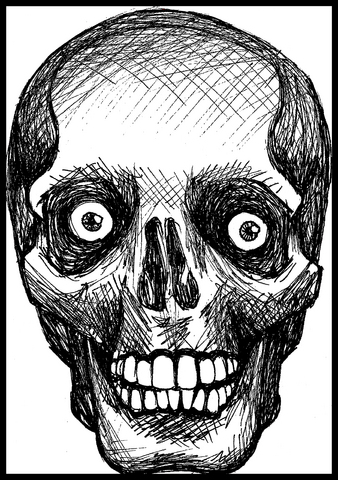
skulldrawing“They’ll look. A skull is more interesting than a naked woman.” — Ingmar Bergman, The Seventh Seal

I woke up feeling ill. I choked down Pepto tablets and wrote about other things, but every glance at the clock brought the confrontation closer. I had dry heaves at the thought of setting foot inside the cadaver lab. The first thing that made me feel better was the decision that I didn’t have to go. I didn’t have to face death.

I was afraid to disappoint Tom, the man who’d offered to guide me through my first human dissection. During the school year, he taught human and comparative anatomy at a small university in Northern California.

It would be worse to throw up into a trash can than bail out, I decided. When I finally met him later that morning, I told Tom, “I don’t think I can do this.”

“It’s up to you,” he said amiably. “I’ve seen them before.”

I was amazed he could be so casual about the whole ordeal. Then again, he was taking me into the lab as a favor to his sister Ann Marie, my traveling companion. She’d initially asked Tom’s help to order me a fetal pig, so I could conduct dissection experiments in the privacy of my kitchen. He’d countered by offering to lead me through a fetal pig. As we passed messages through Ann Marie, he understood that what I was really interested in was human anatomy — and offered to allow me to dissect a human corpse.

Faced with the prospect now, I wished we’d started with the pig. Partly, the issue wassize: the fetal pig would be shorter than my forearm. It was controllable. Manageable. The thought of cutting into anything as big as me was scary.

“How about if we go out and look at that graveyard?” Ann Marie encouraged. She’d arranged the cadaver date for me, but never planned to accompany me. I would be alone with the corpse and Tom and the fear in my gut.

I knew that walking in a graveyard would make me feel better. A little fresh air and a walk around, looking at tombstones, would settle my stomach. I loaded film into my camera and got ready to go.

As we wandered through the churchyard, I wondered why I set challenges for myself that disorder my insides. Is it because I’m basically squeamish? I was furious with myself for being such a wimp. After we’d looked over all the headstones, I asked Tom, “Can we at least go up to the school? I don’t want to come this far and just turn tail.”
*
Simply stepping into a science classroom after so many years felt strange. The room full of rows of black countertops with sinks, tall stools pulled up alongside, was like a dream from my childhood. It had been eighteen years since I dissected a fetal pig in ninth-grade Biology. The lessons learned had long since returned to the ether, but this place brought them back to haunt me.

My stomach was still knotted. In the back of the lab, Tom drew out his sketchbooks. He was a graduate student in anatomy, studying muscular development in fetuses. I admired page after page of his illustrations of the delicate structures of fetal pig legs. Tom delineated the direction of the muscle fibers on one page. Another drawing sunk down a layer to reveal the tendons and blood vessels passing through the muscles. The next page showed the manner in which the muscles attached to the bones.

I’d never seen scientific sketches so detailed, so beautiful. These were works of art, planned and executed to lead your eye, shaded so expertly it seemed you could touch the textures with your fingertips. Their perfection was meticulous, worshipful. The sketches reminded me why I had wanted to be here in the first place. I wanted to understand the holy mysteries inside my body.

“I think I’m ready to look at the cadavers,” I said.

Tom met my eyes and smiled.
*
I had a lot of preconceptions when it came to handling corpses. I’d imagined myself standing before a wall of stainless steel freezer drawers like at the Mortuary College in San Francisco. In my imagination, the cadavers were draped with crisp white sheets. The bodies would be antiseptic. I expected them to be frozen. I thought everything would be as clean and neat as a television morgue.

The cadavers would be male, of course. I thought I could depersonalize a dead man more easily; I might empathize too much with a woman as the scalpel in my hand sliced her flesh.

Tom quickly rearranged my expectations. “Three of the four cadavers here are female,” he said. “I usually start people out with the women, since they’re the most taken apart. That’s a little easier for people to deal with.”

The bodies weren’t kept in refrigeration units. Instead, they were already waiting in the front of the classroom, lying in long stainless steel bins with wheeled legs and a hinged two-piece top. When Tom folded open the top, clear fluid spilled onto the floor. “Condensation?” I hoped.

“And some preservative,” he answered. When the worst of the runoff had stopped, he let the top hang down and opened the other side.

I was amazed we’d been in the room with the bodies all along. One of my memories still clear from ninth grade dissection was the horrible, headache-inducing smell of formaldehyde. I was glad preservative technology had improved.

A length of muslin floated atop the brownish red liquid. Blood, I thought immediately, and recoiled. Too thin for blood, it looked more like beef broth. Pools of oil slicked the surface.

“See that handle there? You can help me by turning it.” Tom moved to the far end of the tank.

There should have been scary music playing as we cranked the cadavers out of the fluid. As the bodies slowly rose, the muslin took on their outlines. Through the shroud, I saw bared teeth and the flensed musculature ofjaw. Two corpses lay head to feet. The skin had clearly been flayed from their muscles.

If Tom had made them twitch, I would have leapt out of my own skin.

He pulled on some heavy turquoise rubber gloves and folded the muslin so it shrouded both faces and one entire body. The other lay revealed. Her skin had been stripped away. She had no breasts. The muscle fibers of her chest were very directional and clear, the raw color of a New York strip steak. Some of the muscles on her arms had been removed to show the bones and tendons beneath. Her fingertips still had nails and skin. The skin was the color of dried blood.

“Do you leave the fingerprints on for identification purposes?” I asked.

“No,” Tom answered. “Removing those pieces of skin is really difficult without damaging the tendons underneath. And leaving them on helps to prevent the bodies from drying out and becoming mummified by the preservative solution.”

Atop her belly lay a yellow layer of fat, like the fat under the skin on a chicken: the color of butter and deeply repellant. The abdominal muscles had been sliced along one side. Tom tucked his gloved fingers into the gap and folded the meat back like opening a door. Intestines coiled inside as tight assausage in a shrink-wrapped package.

I stepped back to suck on my water bottle. “Have you ever seen anyone puke?”

“No,” Tom said. “And someone’s only passed out on me once. But I got lightheaded the first time. Both of these ladies’ eyes are open. My first experience was this person staring at me.” He waved at the one still hidden by the shroud.

“That would be hard. How long has she been here?”

“Longer than I have. I think she got here the semester before I started.”

“How do people donate themselves?” I asked. “Do they leave their bodies directly to the College?”

“No. What happens is that you make arrangements to leave your body to science. Any number of things can happen to it. You can end up as histological sections in a jar, or on microscope slides, or you could wind up like this. You can’t specify what will happen to you.”

“So the College puts in an order: ‘My department needs to have a full cadaver’?” I asked.

“Yep.”

“Is there a national pool or something?”

Tom chuckled. “No, we purchase ’em down at UC-Davis. There used to be a mortician school that we bought from, but the people we buy from now do it professionally. Their job is to prep cadavers for this. They’re like $750 a piece. I’m sure an eighteen-year-old who died of a cocaine overdose on the basketball court would be more expensive. Those people don’t go to us. They go to a medical school, if they get donated at all. Young people are very uncommon. Most of these people are well-educated professor-types. The guy here was a lawyer.”

Surprised that Tom would know so much about them, I asked, “Do you know what they died of?”

“Some of them, yeah. I’ve seen their death certificates. One of these women died of cardiopulmonary failure, but her organs are full of cancer. The man in that other bin died of cardiac arrest. The woman we’re looking at now had multiple sclerosis, but the cause of death on the certificate is respiratory failure.” He shrugged. “That’s one thing about death certificates: they’re not all that helpful unless you know something about the case. Usually, if it’s an old person who died in the hospital of respiratory failure, a number of other things had probably already gone wrong.”

“I read in How We Die that it’s almost always pneumonia that finishes you off after other diseases have their way with you.”

He nodded and met my eyes. “Ready?”

I moved over to the edge of the bin and gazed down at the dead woman. Her sparse black pubic hair curled like wire above skin discolored to the orangish brown of tanned leather. I didn’t get sick or pass out. My brain simply separated from my body. I became nothing but eyes. “Could you start me out slowly?” I asked. “Just point out what we’re looking at?”

“Sure,” Tom said. “Her abdominal cavity is open. Humans have three body cavities. Think of the chest as thoracic. The abdominal cavity is separated from the thoracic space by a muscular diaphragm, which is this right here.”

He ran his gloved fingers under an opaque membrane.

“Wow, it’s really thin!”

“But it’s tough stuff. What the diaphragm does is separate this body space where the heart and lungs are from this body space where the stomach and liver and intestines live. There are only a few things that go through it. There’s a big artery that goes through it — ”

“The central one?”

“Yes. It’s called the descending aorta in humans. See where I cut it off?” Tom put his index finger into the collapsed blood vessel to show me its diameter. “This enormous artery feeds everything from here down.”

He shifted the loose organs around inside the cadaver. “Here is the stomach and the liver. The muscular diaphragm sits on top of that. Here’s part of it.” He pulled a piece of membrane out from under the dull cranberry-colored lungs. They looked like sponges. “The only things that pass through the diaphragm are the descending aorta and a large vein, which brings all the blood back up to the heart. That’s the inferior vena cava.”

“And the esophagus goes into the stomach,” I said.

“Right. So those are the only things that go through the diaphragm. Other than that, it’s a closed-off space. It’s sealed completely with a membrane called the peritoneum.” He looked at me. “You’ve heard of peritonitis?”

“That’s when the membrane gets inflamed?”

“That’s right. It’s an infection of this membrane. If you puncture the membrane, anyone will get peritonitis. Women are at particular risk, though, because the fallopian tubes just open up into the body cavity. There’s no connection between them and the ovaries. So there’s an opening into that body space in women that men don’t have, an opening from the outside.”

“Where the infection can travel up.”

“Exactly,” Tom said. “That’s why hygiene is so important. Women can get vaginal and urinary infections very easily, because the anus is so close to the vagina and there’s an opening into the body cavity. Once this membrane gets infected, you can die very rapidly. Not only that, but this peritoneum is a continuous membrane, which wraps around inside and comes around to the back and wraps the intestines. It’s as if all the organs are sitting in this space.”

I interrupted, “It’s a design flaw.”

“Not really. What it does is to keep all these things separate from one another to avoid them sticking together, because it produces serous fluid so everything slides against each other. There’s a certain amount of protection from abrasion to the organs and the inside of the body wall. In females, it’s just a problem because of the opening to the outside. Males don’t have to worry about it unless someone sticks something through their body. When people get shot in the abdomen —”

“They die of peritonitis?”

“Usually. It’s a bacterial infection of this membrane. I opened a shark once that had peritonitis. It was really disgusting. There’s really very little in there to protect from infection. You know, if the infection were in the body tissues, there’s a pretty good immune system to take care of it. It’s well-vascularized.”

“It drains,” I translated.

Tom nodded. “Whereas here, this cavity will fill up with fluid. White blood cells fight the infection, but the circulation isn’t the same as in the tissues. The abdomen becomes distended.”

He moved on to the next subject. “Most of the viscera are in the abdominal cavity. That’s the intestinal and digestive organs. The liver is mainly a digestive organ. The spleen is a large lymphatic organ that’s in here, and then there’s the urinary system, and the reproductive organs.”

Tom leaned over the cadaver. “Let me show you something really cool, then we’ll quit.” With his green-gloved hands, he nudged the intestines aside. “This woman was quadriplegic,” he explained, “and never had children. That’s why we use her reproductive organs to teach from, so students can see them in their pre-pregnancy state.”

I leaned closer over the table, intrigued now. The first time I had a Pap smear, the nurse offered to hold the mirror for me so I could see my own cervix. I was scared and uncomfortable and all I wanted was to get my feet out of the stirrups. Now I had the opportunity to see the mystery from another angle.

“This is her bladder.” Tom gestured toward a small onion-shaped organ, smaller than my fist. “See this, lying atop it? That’s her uterus. That’s why, in later pregnancy, women have the urge to pee so often. The baby’s weight presses down against the bladder.” The uterus was a small, unremarkable piece of meat.

“This fringed structure? That’s one of the Fallopian tubes. The other is over here. See how it wraps around the ovary? The egg travels from the ovary into the Fallopian tube, but the two organs are separate.”

The colors of all her internal organs fascinated me. I wondered how different the colors would be in a living or recently dead person. None of the organs had the bright red or blue colors of the plastic teaching torsos I’d seen. In fact, all of them were variations on meat-colored. No wonder the ancients believed we were created from dirt. Fashioning clay figurines must have once been an act of such power! Only the ovaries were creamy white, an unusual color amidst the rest. Because they were so different, they looked as if they had a special purpose.

As much as I wanted to, I couldn’t touch an ovary. I didn’t have gloves on, but worse, I was still afraid of the dead body.

Still, I was so giddy with excitement that I could have done a little dance. The inside of the body was a truly incredible thing that very few people ever get a chance to see. I felt blessed to have been given such a wonderful opportunity. And these women had donated their bodies to science to give exactly this sort of gift! They should be venerated as saints of science.
*
As Tom peeled off his rubber gloves, I asked, “Is that blood in the tank?”

“Maybe a little. Mostly, it’s fungicide, to keep things from growing in there. And it’s probably got some intestinal products in it, too.”

“Don’t they flush the bodies out before you get them?”

“Yeah. But every time you cut into an organ, matter leaks out.” He moved to the end of the tank and we cranked the bodies back down into their bath. “Usually,” he continued, “the preservative isn’t such a mess, but this probably hasn’t been changed all summer. I’d do it now, since the semester’s almost ready to start, but I’m not teaching this term.”
*
That night I ended up accidentally staying alone at Tom’s girlfriend’s apartment. I had asked to be left alone to write, but Ann Marie planned to come back to the apartment to sleep. Instead, she was too tired to return. I’d sort of expected that might be the case, so I was okay with it. Generally I don’t have trouble being alone.

Once everyone left me, I opened my notebook. I was going to write about how frightened I’d been to set foot in a room with dead people, how surprised I was that curiosity kept me upright, kept me looking. I was going to write about the tank where the ladies were kept (I wanted to say ‘lived’). I wanted to describe the bodies and the details of the injuries done them.

But I couldn’t. I knew if I started to write about those things, I would be awake all night. Instead, I wrote about going caving with Ann Marie up in the Modoc area of California. At midnight, I closed my notebook and went to sleep, but I left a light on.

I dreamed that my dad called. My dad never calls. In the dream, he’d been trying to reach me for a couple of days, but Ann and I had been camping in the middle of nowhere, and now I was not staying at the house where I was supposed to be. Dad was calling from a cell phone on a helicopter, flying to Chicago where my grandmother was dying in a special teaching hospital. She’d asked for me. I was supposed to come home immediately.

I woke myself up. Whenever I am stressed, I dream something has happened to my family. There’s never been any correspondence between when I dreamt about someone and when something happened to them. That would be too helpful. InsteadI dream about them when I’m worried about something else.

I looked at the clock. It was 4 a.m. In the morning, Tom was going to lead me through Cadaver #2. More than anything, I wanted to hold a human heart in my hand. I wanted to look into the engine of my own death.

I closed my eyes. All I could see was the torso of a woman whose skin had been removed. The cadavers were up the hill at the college, within walking distance. If they’d wanted to find me, they could have. I don’t think they wanted to frighten me. I was frightening myself.

Despite my anxiety, I felt as if I’d stepped across a threshold, into a holy place that few people see. Our insides are like a puzzle where every element tucks against the next and performs its magic in secret. Life seems even more sacred to me, now that I’ve explored a woman who donated her body to the study of it.

Maybe I needed another walk in a graveyard before I could get to sleep.

-END-

Copyright ©2014 Loren Rhoads

 Loren Rhoads is the author of WISH YOU WERE HERE: ADVENTURES IN CEMETERY TRAVEL, co-author (with Brian Thomas) of the novel AS ABOVE, SO BELOW, and editor of THE HAUNTED MANSION PROJECT: YEAR TWO. For 10 years, Loren edited the cult nonfiction magazine Morbid Curiosity. She also edited MORBID CURIOSITY CURES THE BLUES: True Stories of the Unsavory, Unwise, Unorthodox and Unusual, a collection drawn from the magazine, which was published by Scribner.

Share this:

  • Share on Facebook (Opens in new window) Facebook
  • Share on X (Opens in new window) X
  • Email a link to a friend (Opens in new window) Email
  • Share on Reddit (Opens in new window) Reddit
  • Share on LinkedIn (Opens in new window) LinkedIn
  • Share on Tumblr (Opens in new window) Tumblr
  • Share on Pinterest (Opens in new window) Pinterest
  • Print (Opens in new window) Print
Like Loading...

Reinvention Phase – Things To Come

26 Wednesday Feb 2014

Posted by Josh Perry in General Articles

≈ 1 Comment

Tags

Grave Hunting, The Gravecast Blog


It’s been awhile since I’ve written anything for the blog. So I wanted to keep you all in the loop on a few things. First things first. I’m still in the process of writing the final installment to last October’s third L.A. gravecation. In the last article which I have yet to finish. I chronicle my trek to Forest Lawn Memorial Park – Glendale. The article will be a doozy so it’s taking me awhile to write.

The next thing I wanted to bring to light. Is that around the first week in March. I’m going to take the plunge, and transfer this site to a self hosted domain, and then utilize the wordpress.org software. Instead of using the wordpress.com site to host, and keep up this blog. With that being said I’m also going to change the web address of the blog to thegravecastblog.com. This is due in part because I’m trying to rebrand the blog so its more recognizable.

One thing I wanted to mention on the rebranding of The Gravecast Blog. Is that when I get things up and running on the self hosted side of things. I’ll be including ads on the blog. I’ve been approached by several people who cater in various forms to the death care industry, when people pass away. They asked me if I’d be interested in putting an ad on the blog for their business. I thought it over and decided I could earn some sort of revenue for the blog. The revenue from ads on the blog. Could go towards the funding of future gravecations around the country, upgraded field equipment, and the general upkeep of this blog.    

The last thing I wanted to bring up. Is that I’m bringing The Gravecast Podcast back from the dead. Complete with a new musical intro,  on top of more fascinating topics, and interviewed guests.

It’s all good stuff I’ve got planned. So please stay tuned for the new and exciting things.

0.000000 0.000000

Share this:

  • Share on Facebook (Opens in new window) Facebook
  • Share on X (Opens in new window) X
  • Email a link to a friend (Opens in new window) Email
  • Share on Reddit (Opens in new window) Reddit
  • Share on LinkedIn (Opens in new window) LinkedIn
  • Share on Tumblr (Opens in new window) Tumblr
  • Share on Pinterest (Opens in new window) Pinterest
  • Print (Opens in new window) Print
Like Loading...

2013 L.A. Gravecation Day 5 & 6 – Death Hag Weekend Insanity

05 Sunday Jan 2014

Posted by Josh Perry in Gravecations - Stories From The Road

≈ Leave a comment

Tags

Angelus-Rosedale Cemetery, Biograph Company, Black Dahlia Murder, Death Hag, Eden Memorial Park, featured, Groucho Marx, Harvey Lembeck, John Gilmore, Jonathan Hale, Los Angeles, Mark Masek, Michael Gilden, Phil Foster, Scott Michaels, The Gravecast Blog, The Motion Picture Country Home, Tod Browning


On Saturday October 5th, I’d been in the Los Angeles area for five days. With the 2013 L.A. Gravecation approaching on the horizon of coming to an end. There was still much to see, and do. On this particular day I made plans to visit Angelus-Rosedale Cemetery, and attend the final night of the 2013 Dearly Departed Death Hag Weekend.

angelusrosedalerandom02

The History: Angelus-Rosedale Cemetery

Angelus-Rosedale Cemetery, nestled on 65-acres of historic cemetery real estate. It was founded in 1884. Originally christened Rosedale Cemetery. In 1993 the cemetery became known as Angelus-Rosedale when nearby funeral home Angelus Funeral Home, bought the cemetery from the previous owners.

Some of the more illustrious movers, shakers, & politicians in early Los Angeles history who are buried, or interred in Angelus-Rosedale include many former mayors of Los Angeles who call this cemetery their final home. Angelus-Rosedale is considered to be one of the first cemeteries west of the Rocky Mountains to incorporate the design features usually seen in garden cemeteries. This style of cemetery/memorial park is a popular landscaping feature in cemeteries/memorial parks around the country. Some of the key highlights of a garden cemetery include beautiful and decorative tree plantings, shrub varietals, flowers, natural scenery and works of monumental art. If you’re interested in learning more about the rural/garden cemetery movement, feel free to visit Wikipedia. Take it from me if you visit a garden cemetery in your region, be ready for an overabundance of photo opportunities. One of the things I find interesting about Angelus-Rosedale cemetery is that it was the first cemetery in Los Angeles to offer burial services to people from different ethnic backgrounds. Not only that, in 1887 the cemetery became the second in the United States (the first west of the Rocky Mountains) to perform on site cremations. If you’re interested in learning more about this small yet tranquil historic Los Angeles burial ground, you should definitely visit the Wikipedia or Find A Grave pages.

The Tour: Angelus-Rosedale Cemetery

Upon my arrival at Angelus-Rosedale, I had a game plan set in motion to whose graves I wanted to find at this historic cemetery. However, unbeknownst to me, as I’d quickly found out when I arrived at the cemetery, I discovered that the cemetery office was closed for the day. So with this in mind and knowing I wouldn’t be able to get a much needed cemetery map. As this was the first time I’d been to Angelus-Rosedale. I had to start thinking rather quickly on how I’d go about finding the three other graves I wanted to find, (aside from the one I found in the mausoleum) who were buried on the cemetery grounds.

Before the unsuccessful trek around the cemetery, I made my way towards the Angelus-Rosedale Mausoleum & Columbarium. Inside this very cool building, I felt an aura of a Gothic atmosphere, due to the dimmed lighting and overall decrepit nature of the building. I made a leisurely stroll inside while admiring the creepy ambiance of the mausoleum until I came upon the “Eternal Light” hallway. It was in here, where after strolling about for several minutes, that I came upon the cremains niche of prolific horror film director Tod Browning.

Tod Browning

(July 12, 1880 – October 6, 1962)

Located roughly halfway down the hallway on the right side of the corridor wall, in niche 20648 isprolific actor, director, & screenwriter Tod Browning. He was born in 1880, and spent his youth in Kentucky. He grew tired of home life in the Blue Grass State, and yearned for adventure. He became fascinated at a young age by the glitz and glamor of circus life and the sideshows that went along with the atmosphere. He eventually ran away from home at the age of 16 to follow his dreams of joining the circus.

After leaving the circus, Browning would work odd jobs eventually landing a job at a New York theater. While working at the theater. He had a chance encounter with prolific director D.W. Griffith. Griffith was impressed with his acting abilities, and offered him a job with the New York based Biograph Company. In 1913 Griffith severed his affiliation with The Biograph, and decided to head west. In his wake Browning followed Griffith to California, and continued to act in his films.

In 1917, Browning made his film début as director with the silent era film Jim Bludso (1917). After the positive response of this film, he hightailed it back to New York for a year to work on other motion pictures. In 1918, he beelined it back to California and produced a few films for Metro.

Out of the sixty-two motion picture director credits Browning has to his name, a couple of his more prolific films include Dracula (1931), which starred Bela Lugosi & Freaks (1932), which is a motion picture featuring grotesque sideshow freaks in various forms.

In October of 1962 while residing in Santa Monica at the home of some friends, Browning, who was a lifelong smoker succumbed to complications of cancer. At the time of his death, he was 82 years old. If you’re interested in learning more about his fascinating life feel free to cruise over to Wikipedia, or Find A Grave, also the book “Dark Carnival: The Secret World of Tod Browning Hollywood’s Master of The Macabre” by David Skal is probably a good choice to read if you’d like to get into the mindset of Tod Browning’s cinematic work. And finally if you’d like to see his full film credits listing, IMDb is the place to be.

After I was finished photographing the graveside niche of film director Tod Browning, I decided to make an attempt to find the graves of the three celebrities buried in the cemetery who I had locations for. There was just one miniscule problem. Besides not having a cemetery map due to the office being closed, pretty much all the markings where the section letter/number would be throughout the various sections on the curb were illegible. So it was hard to determine which section was which. Keep in mind I had the section and lot numbers for the three people I was looking for but gave up trying to find them.

The three people buried in the cemetery who I had no luck finding werelandowner and the namesake for Burbank, CA, David Burbank, Silent era actress Louise Glaum, and Marshall Neilan who was a silent era actor, director, screenwriter, and producer. After I was finished doing what I do best at Angelus-Rosedale Cemetery, It was time to cruise up to Altadena, California to Mountain View cemetery to partake in night two of The 2013 Dearly Departed Death Hag Weekend insanity.


Death Hag Weekend: Night Two – Mountain View Cemetery Dinner Party

Before I get started with this section. I want to take a moment to explain what a “Death Hag” is. Simply put a “Death Hag” is someone who’s fascinated by any and all accounts of death. In particular the deaths of famous, or notable people. The brainchild behind the “Death Hag” phenomenon is my friend Scott Michaels. Scott pretty much carved out his own sort of cult following as the owner of the Los Angeles based Dearly Departed Tours, which is a boutique sightseeing tour venue in Hollywood. Dearly Departed Tours showcases the locations where celebrities have met their untimely demise, or some tabloid worthy incident, or scandal took place. Scott also owns/maintains the highly informative website Find A Death, which chronicles the last moments of celebrities in biographical form. Hence the name “Dearly Departed Death Hag Weekend”. The weekend event is an annual gathering in Los Angeles, of like-minded people who share the same interest when it comes to celebrities or notable people dropping dead.

Despite the morbid nature of the annual weekend, the primary goal of the gathering which has now taken place for the past two years, is to raise money to mark the grave of an unmarked celebrity burial site, or cremain’s niche. It’s a way to honor the celebrity because even the most beloved or obscure celebrities who don’t have a grave marker for whatever reason, should be remembered. This year, the donations raised from the raffle giveaway, and other raised proceeds at The 2nd Annual Dearly Departed Death Hag Weekend went towards paying for the beautiful grave marker for beloved actor Jonathan Hale, who’s best remembered for acting in the “Blondie” movies, and several episodes of “Superman”. Hale committed suicide while living out the remainder of his days at The Motion Picture Country Home on February 28th 1966.

Some of the key highlights of the Saturday night gathering inside the Pasadena Mausoleum, on the grounds of Mountain View cemetery included a fascinating, and extremely well researched presentation by Mark Masek. The presentation related to the Lamb Funeral Home scandal which also involved Mountain View cemetery. If you’re interested there’s a true crime book which chronicles the scandal in detail. The book is titled “Chop Shop” and is written by Kathy Braidhill. From what I’m told by friends who’ve read the book is that it’s a page turning fascinating tome.

Another key highlight of the Saturday night revelry inside the Pasadena Mausoleum was the thought-provoking presentation given by noted actor, and author John Gilmore. Gilmore, along with his various acting roles, wrote a handful of books related to L.A. noir, true crime, and fiction. He presented some of his personal theories into the infamous Black Dahlia murder, and other crimes that took place in L.A. history. I found his theories to be really intriguing. After Gilmore was finished with his highly informative presentation. I mingled among the 100+ party goers before the night commencedand The 2nd Annual Dearly Departed Death Hag Weekend came to a close.


On Sunday October 6th, I realized I had two days left of cemetery grave hunting in Los Angeles before hopping on a plane at LAX, and heading home on Tuesday October 8th. In situations like this, it’s customary for me to kick things up a notch. So what did I do? I hightailed it to Eden Memorial Park.

The History: Eden Memorial Park

Situated at the northern edge of the bustling San Fernando Valley, 15 miles to the northwest of Hollywood. In an area surrounded by beautiful mountainous ranges, is where you will find Eden Memorial Park.

Opening in 1954. Eden Memorial Park by all means, isn’t one of Los Angeles oldest Jewish burial grounds. Nor is it one of the more well known memorial parks compared to the other three Jewish cemeteries used primarily for Los Angeles residents who happen to be Jewish. However due to the rather serene placidity, you will encounter strolling around this beautiful memorial park, with the steeply inclined hillside slopes. Make this cemetery a true hidden gem for seasoned grave hunters alike. 

As you make a leisurely stroll around Eden Memorial Park, take note of the key points of interest. One of the beautiful exhibits you definitely should checkout which is a key feature of Eden Memorial Park. Is the well-known mural titled “The Twelve Tribes of Israel” by Joseph Young. Completed in 1959, this large mosaic is depicted in the center of the cemetery, on the garden mausoleum wall. This particular painting is a masterful work of art that spans 18-feet above the ground. “The Twelve Tribes of Israel” mosaic is a breathtaking pre-cast Byzantine bas-relief.

Keep in mind if you plan to visit Eden, due to the cemetery is surrounded by tall shrub plantings, along the bordering streets. This factor alone was put in place to keep the cemetery hidden from the average person discovering the tranquil oasis from the road. With this in mind your going to need a GPS device to pinpoint the location of the cemetery.

The Tour:

Upon my arrival at Eden Memorial Park. I eased my vehicle to a stop inside the cemetery. So I could pinpoint my game plan. Being that I had no desire to get a cemetery map which usually does come in handy. I had a better tool at my disposal. In the form of two L.A. grave hunting books. Most notably “L.A.’s Graveside Companion Where The VIP’s RIP” by Steve Goldstein, & “Hollywood Remains To Be Seen: A Guide To The Movie Stars Final Homes” by Mark Masek. Both Mark, and Steve are personal friends of mine, who I’ve had the utmost honor tograve hunt the days away during past L.A. Gravecations.

Being that there aren’t an “insane” amount of celebrities who are buried, or interred in Eden Memorial Park. The cemetery does have a nice dose of well-known celebs buried/interred here. If your interested to checkout the who’s who list of celebrities, and other Hollywood personalities buried in Eden Memorial Park. Checkout Find A Grave, or Wikipedia. As you’ll see, during my visit to Eden Memorial Park, I only found a few celebrities. The first on the list was prolific comedic actor Harvey Lembeck.

Harvey Lembeck

April 15th 1923 – January 5th 1982

Located in the NE corner of Mount Jerusalem a few steps below the Court of David section is where you will find prolific actor Harvey Lembeck. Lembeck was born in April 1923, a Brooklynite since birth, Lembeck got his official start in showbiz after graduating from New York University in 1947. At the time he was one half of the dancing duo “The Dancing Carrolls”. As time went on Lembeck’s prominence and virtuoso abilities on New York’s Broadway stages, the silver screen, and lets not forget to grace the TV sets in the homes of families across America. When it comes to television Lembeck is mostly known for his character roles on The Phil Silvers Show (1955), Stalag 17 (1953) and Ensign O’Toole (1962). As for the silver screen Lembeck usually portrayed the tough guy biker bad ass, or greaser gang leader, in the beach party movies of the 1950s, and 60s.

Moving along as the 1980s were on the horizon. Lembeck’s acting career was very much in full swing. In 1982 while performing in an episode taping of the TV show “Mork & Mindy” Lembeck collapsed from a heart attack and died on the spot. If you’re interested in seeing a more detailed biographical overview of Harvey Lembeck’s life, and acting career. Feel free to visit Wikipedia, or IMDb. After photographing the graveside of Harvey Lembeck. I then made a leisurely stroll a few steps away to the graveside of another Brooklyn born actor/comedian & that being Phil Foster.

Phil Foster

March 29th 1913 – July 8th 1985

Located In Front Of The Mount Jerusalem Mausoleum in lot 318H and a few leisurely steps away from Harvey Lembeck is where you will find Phil Foster. Born on March 29th, 1913 in Brooklyn. Foster began his ascent into showbiz when he started singing and dancing in front of movie theaters. As time went on Foster would compete in talent competitions. As the Great Depression was rolling on, Foster started partaking in the dramatic form of acting. Due to the fact that theaters weren’t operating he began performing in halls, backrooms, and other venues. In the late 1930s while living in Chicago. Foster began performing  as a stand-up comedian. As time went on his popularity as a stand-up comedian grew. Nationally Foster was in constant demand to perform at top-notch comedy clubs.

During WWII, Foster enlisted in the United States Army. After serving the country during the war. He returned to New York. Due to the stories he’d elaborate on from his youth, Foster became a variety show regular. In the 1950s Foster appeared in the science fiction movie The Conquest of Space (1955). Other TV appearances included: Games People Play, The Ed Sullivan Show and Toast of the Town along with This Is Show Business, The Tonight Show Starring Johnny Carson, Love Boat, and The Patty Duke Show. Out of all the TV appearances Foster was involved with. He’s most fondly remembered as Frank DeFazio on Laverne & Shirley.

Foster was a highly versatile actor & comedian who recorded multiple stand-up comedy albums, on top of being a playwright, and finishing a few story outlines. In July 1985, at the age of 72, while living in Rancho Mirage, CA. Foster passed away from a heart attack. If you’re interested in checking out Foster’s film/tv credits feel free to cruise over to his IMDb page.

After photographing the graves of actors Harvey Lembeck, and Phil Foster. I casually drove around the cemetery planning my next move. I then cruised over to the Court of Abraham North section where actor and stuntman Michael Gilden rests alongside some family members.

Michael Gilden

September 22nd 1962 – December 5th 2006

Located in The Court of Abraham North section in lot 2133 is actor and stuntman Michael Gilden. Gilden who was a native of Los Angeles was one of many actors who were born with a form of dwarfism. Gilden did stunt work for several episodic TV series, and motion pictures. Some of the TV shows he performed in include: Charmed, CSI: Crime Scene Investigation, Family Law, Cybill, and NCIS. Moving along some of the motion pictures Gilden was involved with include: “Star Wars: Episode VI-Return Of the Jedi (1983), “Freaked” (1993), “Once Upon A Christmas” (2000), “Snow White” (2001), “Nudity Required” (2003), “Southland Tales” (2006), “Against Types” (2006). In 2006 while living in the Los Angeles area with his wife Meredith Eaton-Gilden another actor with dwarfism. Gilden took his own life.

One of the things I wanted to point out on Gilden’s untimely passing. Is that when I visited his graveside in Eden Memorial Park. His father who’s also buried a few steps away. Passed away a few days before Michael took his own life. So I came to the conclusion that perhaps he couldn’t deal with his father passing away. If you’d like to see Gilden’s full film/tv credits checkout his IMDb page.

Groucho Marx

October 2, 1890 – August 19, 1977

Rounding out the tour at Eden Memorial Park. No visit to the cemetery would be complete without visiting the cremains niche, and paying homage to Julius Henry Marx. Who’s fondly remembered as comedian Groucho Marx.

Groucho Marx cremains niche is in a small room located within the garden mausoleum in the center of the cemetery. This small room is located roughly 200ft from the western edge of the outdoor mausoleum. It’s kinda hidden so look for it. Once you find the hidden room, open the door (hopefully it’s not locked) and canvas the back facing wall of the room. Located roughly in the center of the wall and eye level is his cremains niche.

Known as the master of the quick wit, Groucho along with his brothers Chico, and Harpo was the  sibling trio of the Marx Brothers comedy troupe. Marx, along with his brothers grew up on Manhattan’s upper eastside. Getting their start in showbiz by doing acts on the vaudeville circuit. The family would eventually head west to Hollywood.

In all Groucho Marx made 26 movies, 13 of them were with his brothers Chico, and Harpo. Of the 13 films Marx made with his brothers The Cocoanuts, Animal Crackers, Monkey Business, Horse Feathers, Duck Soup, and A Night at the Opera were probably their more popular. In June 1977 Marx was hospitalized at Cedars Sinai Medical Center in Los Angeles from complications of pneumonia. Two months later on August 19th Marx succumbed to the disease. If your interested in reading a detailed online biography on Groucho Marx, feel free to visit Wikipedia, or IMDb for his film credits.


So that pretty much concludes the “2013 L.A. Gravecation Day 5 & 6” article. Stay tuned for the Day 7 finale where I trekked to Forest Lawn Memorial Park – Glendale. If your interested to see the photos from the Day 5 & 6 insanity. Feel free to check them out below.

This slideshow requires JavaScript.

Share this:

  • Share on Facebook (Opens in new window) Facebook
  • Share on X (Opens in new window) X
  • Email a link to a friend (Opens in new window) Email
  • Share on Reddit (Opens in new window) Reddit
  • Share on LinkedIn (Opens in new window) LinkedIn
  • Share on Tumblr (Opens in new window) Tumblr
  • Share on Pinterest (Opens in new window) Pinterest
  • Print (Opens in new window) Print
Like Loading...

2013 L.A. Gravecation Day 3 & 4 – The Insanity Rolls On

05 Saturday Oct 2013

Posted by Josh Perry in Gravecations - Stories From The Road

≈ 3 Comments

Tags

2013 L.A. Gravecation, Erin Murphy, featured, Hollywood, Hollywood Orchid Suites Hotel, L.A. County Coroners Office, Los Angeles, Los Angeles 2013 Death Hag Weekend, Rose Hills Memorial Park, San Fernando Mission Cemetery, Walter Brennan, Whittier CA


Being that I overslept, and I mean WAY overslept, the day after I arrived in Los Angeles and thus missing out on a full day of grave hunting insanity. I made a wise decision to not make that crucial mistake again. Because as we all know vacation time is precious. So on Thursday, October 3rd, I had a few things planned.

First on the agenda was revisiting San Fernando Mission Cemetery, in Mission Hills, set in the bustling San Fernando Valley. This time I wanted to get a more definite overview of those Hollywood personalities who call this tranquil Catholic cemetery their final home. After the  San Fernando Mission Cemetery trek I attended the Thursday night “death hag” weekend pre-party at The Hollywood Orchid Suites Hotel. On Friday I’d be visiting Rose Hills Memorial Park, in Whittier. After the trek at Rose Hills Memorial Park, I bee-lined it for Hollywood for some pre-coroner’s office party drinks with friends at the bar inside the Arclight Hollywood Theater. So let’s get started.

The History: San Fernando Mission Cemetery

The History part of this article is a re-post from the article I wrote last year during my second L.A. Gravecation and is titled “2012 L.A. Gravecation Day 12-13: Had a Helluva Good Time Bon Voyage Los Angeles“
The San Fernando Mission Cemetery, is adjacent to the historic San Fernando Mission, and across the street from Eden Memorial Park. The Mission was founded in 1797. The cemetery itself wasn’t built until about 1800. If you’re interested in learning the condensed version of the history of the San Fernando Mission visit Wikipedia. The old burial ground was intended for “Christianized Indians”, the first burial took place in 1800. Also buried in the old graveyard are early European settlers and several priests. The last burial in the old cemetery took place in 1852.

The new San Fernando Mission Cemetery was opened in 1952, roughly 100 years to the day when the old cemetery met its capacity. It is owned, and maintained by the Catholic Archdiocese of Los Angeles, and is just one of about 11 or so Catholic cemeteries in Los Angeles County. The cemetery encompasses roughly 86 acres of prime burial real estate. Highlights on the grounds among the palm trees include the Spanish-style architectural buildings, among other highlights. If you’re interested in checking out what this historic cemetery has to offer, and who’s buried there, visit the San Fernando Mission Cemetery, Wikipedia, or Find A Grave pages.

The Tour: San Fernando Mission Cemetery

Upon my arrival at San Fernando Mission Cemetery, I cruised over to the cemetery office in the mortuary building to obtain a much-needed cemetery map. After obtaining one, off I went into the abyss.

With the cemetery trek underway, the first order of business was to track down the gravesite of highly-prolific actor Walter Brennan. Born in 1894 in Lynn, Massachusetts, to Irish immigrant parents. In high school he developed a love for various forms of acting, and that’s where he found his niche. A veteran of WWI, he’d eventually relocate to Los Angeles to pursue his budding acting career. Although he had many fine, starring and co-starring roles, he was best known for being a talkative old-timer or gold prospector in western films and TV shows. One of the things I find fascinating about Brennan is that he’s one of three actors to be awarded the Academy Award on three different occasions, between 1936 and 1940 (The others were Jack Nicholson and Daniel Day-Lewis). In 1974 at the ripe old age of 74, or 80 (depending on the source), Brennan succumbed to complications of emphysema. He’s interred in Section: D, two rows in from curb #445. If you’re interested in reading more about his life, and highly prolific career, you should definitely checkout his Wikipedia page.

After photographing, and paying my utmost respects at the graveside of Walter Brenna I cruised over to the graveside of Fred Niblo Jr. As you probably guessed Fred Niblo Jr. is the son of prolific Hollywood director/producer/actor Fred Niblo Sr., who’s noted for directing acting icon Douglas Fairbanks in “The Mark of Zorro.” (1920).
Niblo Jr. was a prolific screenwriter in his own right during his time in motion pictures. Born in New York City, Niblo Jr. would eventually receive an Oscar nomination for screenwriting for the film “The Criminal Code” (1931). He co-wrote “You’re in the Army Now” (1941) starring Jimmy Durante, Phil Silvers, and Jane Wyman. The rest of his twenty year career would be spent writing action films for the studios Columbia, Warner Bros., RKO, and Fox. In 1950 he retired from the film industry, and became a businessman. It’s unknown to me, at the moment, what his cause of death was. After photographing, and paying my respects at the grave of Fred Niblo Jr. I had many other celebrity graves to find. Unfortunately after trying to find them with much desired luck. I came up empty-handed.

Death Hag Weekend: Pre-Party

After grave hunting at San Fernando Mission Cemetery I cruised back to my nearby hotel. So I could pretty much relax and freshen up before the 2013 Death Hag Weekend pre-party. The pre-party was held at The Hollywood Orchid Suites Hotel which is steeped in Hollywood history and is also reported to be haunted by several ghostly apparitions. Upon my arrival I made a leisurely stroll to the pool where I proceeded to light up a cigar and await the arrivals of some new, and old friends alike. I was at the party for a few hours mingling, sharing stories of my own, grave hunting in the Detroit area where I’m from, and working in the TV/film industry there. After a few hours hanging around at the Death Hag pre-party. I decided to leave and head for my San Fernando Valley hotel room.

The History: Rose Hills Memorial Park

Located in the Los Angeles suburb of Whittier on a large parcel of land once a part of the Rancho Paso de Bartol is Rose Hills Memorial Park. The park was founded in 1914 by land developer Augustus Gregg. At that time the cemetery was known as Whittier Heights Memorial Park, and surrounded 18 acres, of burial real estate. As time went on, and the region around Whittier expanded, so did the memorial park. Today Rose Hills Memorial Park encompasses a staggering 1,400-acres of prime, burial real estate and holds the undisputed distinction of being the largest cemetery/memorial park in the United States. If you’re interested, the Rose Hills Memorial Park website has a pdf booklet available titled “Touring Rose Hills” this 11-page booklet gives visitors a self-guided walking tour, of the grounds and some of the key architectural highlights of the memorial park. Unfortunately the booklet does not mention any of the famous people buried/interred, in the memorial park.

The Tour: Rose Hills Memorial Park

Upon my arrival at Rose Hills Memorial Park I soon realized after visualizing the panoramic views witnessed in front of me that I’d be in serious need of a map. Because there was no way in hell I’d be able to navigate around the cemetery without one. Take it from me. This place is beyond huge when it comes to normal acreage standards in cemeteries. So the first thing I did was get one from the information booth at the front gate. Due to the fact that I was crunched for time I narrowed the list I compiled down from 11 celebrities to just two celebrities. One of those two I did not find, was Boyd Coddington, star of the reality TV show “American Hot Rod”, this was due in part to me crossing paths in the cemetery with a few burial plot salesmen who were looking for a random grave, who insisted on helping me when I did not need it. You gotta’ love friendly people in the cemetery. The other gravesite I had the utmost desire to find was that of “The Godfather Of Gangsta Rap” Eric “Eazy-E” Wright. This time I succeeded without the help of the nosey cemetery employees.

Eric “Eazy-E” Wright
b. September 7th 1963 – d. March 26th 1995

After getting the cemetery map I drove around the memorial park looking for the “Lupine Lawn” section. During my joyride around the largest cemetery in the United States. I came upon a cemetery employee on the grounds. With the way he was dressed I assumed he was security, or had some sort of management position. After I cruised up to where he was standing, I casually asked where the “Lupine Lawn” was too which he replied something along the lines of “who are you looking for.” So I casually gave the last name, then mentioned the first name. To which the gentleman asked was he a “rapper” to which I replied “Yeah in the 90s.” He replies “I can’t give out that info” walks a few steps, then walked back towards me in my car, and said something along the lines “Here’s what I can do. Here’s how to find him.” He then marks the precise area on the map where “Eazy-E” is buried. Then say’s something like, “this is all the info I can give you. I’m sorry but Eric’s name was taken out of the database a few years ago and we’re not supposed to reveal the location.” I then thanked him graciously for the intel, and then went about finding “Eazy-E,” who’s buried several spaces in from the curb in the south-western part of this section. If you’re interested in reading about Eazy-E’s charismatic rise to fame, and sudden downfall read his bio on Wikipedia.

To make a long story short. On February 24, 1995 “Eazy-E” was admitted to Cedars Sinai Medical Center, due to what he believed to be asthma related. As fate would turn out he was diagnosed with the HIV/AIDS virus. Less than a month later, on March 16th, he went public with the diagnoses during a televised press conference . Ten days after that and nearly a month to the day of the initial diagnoses Eazy-E, passed away from the deadly virus.

After photographing the graveside of “Eazy-E,” I then made an unsuccessful attempt (chronicled above) to find the gravesite of noted custom hot rod builder and reality TV star Boyd Coddington. After my unsuccessful attempt with that. I then bee-lined it for Hollywood. Where I met up with my friend Steve Goldstein, and a few other fellow death hags for a few adult beverages at the bar, inside Arclight Cinemas. After a few rounds of drinks we all decided to make our ascent to the L.A. County Coroner’s Office for the Friday night cocktail party, which also included a tour of the service floor of the coroner’s office.

Death Hag Weekend: Night One – Coroner’s Office Cocktail Party

On night one of the 2nd Annual Dearly Departed Death Hag Weekend which took place on Friday October 4th. Myself, and about seventy-five fellow death hag’s, gathered inside the hospital building which serves as the public services building at the L.A. County Coroners Office complex.

I arrived at the Coroner’s office a little after 6pm. Upon my arrival, I mingled with some friends, outside the front doors of the L.A. County Coroner’s Office hospital building. As things got underway, for the night, actress Erin Murphy, who portrayed the character “Tabitha” the daughter of Samantha (Elizabeth Montgomery) and Darrin Stevens (portrayed by Dick York, then Dick Sargent) on the iconic ’60’s & ’70’s TV show “Bewitched” gave a presentation on the celebrities who’ve passed away from the TV show.

After Murphy’s presentation, party goers were given a tour of the coroner’s office in groups of 25. Leading the informative tours was the chief coroner for L.A. County Craig Harvey. Let me just say despite the macabre topic at hand with the tour I participated in. I have to admit it was really interesting.  So that pretty much concludes this article covering day 3 & 4 of my 2013 L.A. Gravecation. Please stay tuned in the next few days as I cover day 5 & 6, 7 & 8 of The 2013 L.A. Gravecation.

This slideshow requires JavaScript.

34.101684 -118.337310

Share this:

  • Share on Facebook (Opens in new window) Facebook
  • Share on X (Opens in new window) X
  • Email a link to a friend (Opens in new window) Email
  • Share on Reddit (Opens in new window) Reddit
  • Share on LinkedIn (Opens in new window) LinkedIn
  • Share on Tumblr (Opens in new window) Tumblr
  • Share on Pinterest (Opens in new window) Pinterest
  • Print (Opens in new window) Print
Like Loading...
← Older posts
Newer posts →

Table of Contents

  • General Articles
  • Tomb Bug Chronicles
  • Gravecations
  • Tombstone Tuesday
  • Tomb Bug Tragedies
  • Tomb Bug Tours
  • Gravecast Podcast
  • Book Spotlight
  • In Memoriam

Archives

Cemetery Websites

  • Bellefontaine Cemetery
  • Elmwood Cemetery
  • Graceland Cemetery
  • Green-Wood Cemetery
  • Highgate Cemetery
  • Hollywood Cemetery
  • Hollywood Forever Cemetery
  • Mount Auburn Cemetery
  • Pere-Lachaise Cemetery

Death Related Websites

  • Encyclopedia of Death & Dying
  • Find A Death
  • Order of The Good Death

Downloadable Cemetery Maps

  • Calvary Cemetery Los Angeles
  • Cave Hill Cemetery – Louisville, KY
  • Clover Hill Park Cemetery Birmingham Michigan
  • Eden Memorial Park Map Mission Hills CA
  • Eternal Valley Cemetery Map Newhall CA
  • Forest Lawn Cemetery Map Glendale CA
  • Forest Lawn Cemetery Map Hollywood Hills CA
  • Glen Haven Cemetery Map Sylmar CA
  • Hillside Memorial Park Culver City
  • Hollywood Forever Cemetery Los Angeles
  • Holy Cross Cemetery Culver City
  • Holy Cross Cemetery Map Culver City CA
  • Melrose Abbey Memorial Park Anaheim
  • Mt. Carmel Cemetery Wyandotte Michigan
  • Mt. Olivet Cemetery Detroit
  • Pierce Bros Valhalla Memorial Park
  • Resurrection Cemetery Clinton Township Michigan
  • San Fernando Mission Map Mausoleum Mission Hills CA
  • San Fernando Mission Map Mission Hills CA Grounds
  • Westminster Memorial Park Westminster CA
  • Woodlawn Cemetery Map Santa Monica CA

Grave Hunting Related Blogs

  • 'Over thy dead body': The Cemetery Blog
  • A Grave Concern
  • A Grave Interest
  • Adventures in Grave Hunting
  • Allan R. Ellenberger's Blog
  • Beneath Thy Feet
  • Cemetery Explorers
  • Cemetery Travel: Adventures in Graveyards Around the World
  • Digital Cemetery Walk
  • European Cemeteries
  • Gardens of Stone
  • Granite in My Blood
  • History In Stone
  • Hollywood: Past, Present, & Future
  • Jewish Graveyard Rabbit
  • LA Morgue Files
  • Louisiana Cemetery Preservation
  • Marble Towns
  • Sleeping Gardens
  • Stone Angels
  • Taphophile Tragics
  • The Association of Graveyard Rabbits
  • The Cemetery Club Blog
  • The Cemetery Traveler
  • The Daily Deceased
  • The Dead Bell
  • The Graveyard Detective
  • The Literary Cemetery
  • Under Every Stone

Grave Hunting Related Websites

  • Beneath Los Angeles
  • Celebrity Grave Hunter
  • David Waller Civil War Grave Hunter
  • Dead Presidents
  • Dead Trek
  • Famous Graves
  • Famous Graves iPhone App
  • Find A Grave
  • Fuller Up The Dead Musician Directory
  • Graves of Gangsters and Bad Guys
  • Graveyards of Chicago
  • Hollywood Forever Cemetery Tour
  • Hollywood Grave Hunter
  • Hollywood Remains to Be Seen
  • Hollywood Underground
  • Morbid Curiosity
  • My You Tube Channel
  • Poets Graves
  • Taphophilia.com
  • The Association of Gravestone Studies
  • The Cemetery Club
  • The Cemetery Project
  • The Dead Ball Era
  • The Dead Rock Stars Club
  • The Gravehunting Video Site
  • The Political Graveyard
  • The Stars of Hollywood Forever
  • Where the Stars Are Buried: Stars' Graves

Gravecast Blog Stores

  • Gravecast Blog Amazon Store
  • Gravecast Blog Zazzle Store

Flickr - The Gravecast Blog

Paul Williams GravesiteMichigan Governor Stevens MasonJohn Lord Booth GravesiteHenry Ford Gravesite
More Photos

Website Built by WordPress.com.

  • Subscribe Subscribed
    Tomb Bug
    Join 47 other subscribers

    Have a WordPress.com account? Log in now.

  • Tomb Bug
    View site in Reader
    Manage subscriptionsSign upLog in
    Report this content
    Collapse this bar
Loading Comments...

You must be logged in to post a comment.

%d