• Home
  • About Tomb Bug
  • Bookshelf
  • Cemetery Etiquette
  • Grave Hunting Primer
  • Gangsters In Granite

Tomb Bug

~ Where Death Meets History

Tomb Bug

Category Archives: Gravecast Chronicles

Grave Hunting stories by grave hunters like you.

Touched by a Cemetery: the National AIDS Memorial Grove | Cemetery Travel: Adventures in Graveyards Around the World

30 Tuesday Sep 2014

Posted by Josh Perry in Gravecast Chronicles

≈ 2 Comments


Loren Rhoads a friend of mine who’s a grave hunter from the San Francisco area. Published an article on September 16th 2014. The article relates to her experience visiting the National AIDS Memorial known as “The Grove” in San Francisco. I thought the article was interesting so I wanted to share it on The Gravecast Blog.

Touched by a Cemetery: the National AIDS Memorial Grove | Cemetery Travel: Adventures in Graveyards Around the World.

Share this:

  • Share on Facebook (Opens in new window) Facebook
  • Share on X (Opens in new window) X
  • Email a link to a friend (Opens in new window) Email
  • Share on Reddit (Opens in new window) Reddit
  • Share on LinkedIn (Opens in new window) LinkedIn
  • Share on Tumblr (Opens in new window) Tumblr
  • Share on Pinterest (Opens in new window) Pinterest
  • Print (Opens in new window) Print
Like Loading...

Gravecast Chronicles – Anatomy Lesson by Loren Rhoads

24 Saturday May 2014

Posted by Josh Perry in Gravecast Chronicles

≈ 4 Comments

Tags

Anatomy, Anatomy Lesson - Loren Rhoads, Grave Hunting, Loren Rhoads, The Gravecast Blog


The next installment of The Gravecast Chronicles comes to us from noted author, Loren Rhoads who’s written several books pertaining to death and cemeteries in general. This article is titled Anatomy Lesson, and let’s just say it was a fascinating story so I hope you enjoy reading it.

Anatomy Lesson – Loren Rhoads

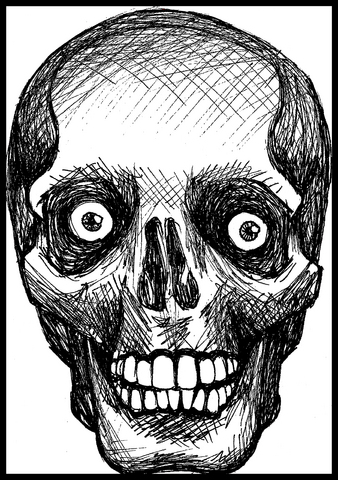
skulldrawing“They’ll look. A skull is more interesting than a naked woman.” — Ingmar Bergman, The Seventh Seal

I woke up feeling ill. I choked down Pepto tablets and wrote about other things, but every glance at the clock brought the confrontation closer. I had dry heaves at the thought of setting foot inside the cadaver lab. The first thing that made me feel better was the decision that I didn’t have to go. I didn’t have to face death.

I was afraid to disappoint Tom, the man who’d offered to guide me through my first human dissection. During the school year, he taught human and comparative anatomy at a small university in Northern California.

It would be worse to throw up into a trash can than bail out, I decided. When I finally met him later that morning, I told Tom, “I don’t think I can do this.”

“It’s up to you,” he said amiably. “I’ve seen them before.”

I was amazed he could be so casual about the whole ordeal. Then again, he was taking me into the lab as a favor to his sister Ann Marie, my traveling companion. She’d initially asked Tom’s help to order me a fetal pig, so I could conduct dissection experiments in the privacy of my kitchen. He’d countered by offering to lead me through a fetal pig. As we passed messages through Ann Marie, he understood that what I was really interested in was human anatomy — and offered to allow me to dissect a human corpse.

Faced with the prospect now, I wished we’d started with the pig. Partly, the issue wassize: the fetal pig would be shorter than my forearm. It was controllable. Manageable. The thought of cutting into anything as big as me was scary.

“How about if we go out and look at that graveyard?” Ann Marie encouraged. She’d arranged the cadaver date for me, but never planned to accompany me. I would be alone with the corpse and Tom and the fear in my gut.

I knew that walking in a graveyard would make me feel better. A little fresh air and a walk around, looking at tombstones, would settle my stomach. I loaded film into my camera and got ready to go.

As we wandered through the churchyard, I wondered why I set challenges for myself that disorder my insides. Is it because I’m basically squeamish? I was furious with myself for being such a wimp. After we’d looked over all the headstones, I asked Tom, “Can we at least go up to the school? I don’t want to come this far and just turn tail.”
*
Simply stepping into a science classroom after so many years felt strange. The room full of rows of black countertops with sinks, tall stools pulled up alongside, was like a dream from my childhood. It had been eighteen years since I dissected a fetal pig in ninth-grade Biology. The lessons learned had long since returned to the ether, but this place brought them back to haunt me.

My stomach was still knotted. In the back of the lab, Tom drew out his sketchbooks. He was a graduate student in anatomy, studying muscular development in fetuses. I admired page after page of his illustrations of the delicate structures of fetal pig legs. Tom delineated the direction of the muscle fibers on one page. Another drawing sunk down a layer to reveal the tendons and blood vessels passing through the muscles. The next page showed the manner in which the muscles attached to the bones.

I’d never seen scientific sketches so detailed, so beautiful. These were works of art, planned and executed to lead your eye, shaded so expertly it seemed you could touch the textures with your fingertips. Their perfection was meticulous, worshipful. The sketches reminded me why I had wanted to be here in the first place. I wanted to understand the holy mysteries inside my body.

“I think I’m ready to look at the cadavers,” I said.

Tom met my eyes and smiled.
*
I had a lot of preconceptions when it came to handling corpses. I’d imagined myself standing before a wall of stainless steel freezer drawers like at the Mortuary College in San Francisco. In my imagination, the cadavers were draped with crisp white sheets. The bodies would be antiseptic. I expected them to be frozen. I thought everything would be as clean and neat as a television morgue.

The cadavers would be male, of course. I thought I could depersonalize a dead man more easily; I might empathize too much with a woman as the scalpel in my hand sliced her flesh.

Tom quickly rearranged my expectations. “Three of the four cadavers here are female,” he said. “I usually start people out with the women, since they’re the most taken apart. That’s a little easier for people to deal with.”

The bodies weren’t kept in refrigeration units. Instead, they were already waiting in the front of the classroom, lying in long stainless steel bins with wheeled legs and a hinged two-piece top. When Tom folded open the top, clear fluid spilled onto the floor. “Condensation?” I hoped.

“And some preservative,” he answered. When the worst of the runoff had stopped, he let the top hang down and opened the other side.

I was amazed we’d been in the room with the bodies all along. One of my memories still clear from ninth grade dissection was the horrible, headache-inducing smell of formaldehyde. I was glad preservative technology had improved.

A length of muslin floated atop the brownish red liquid. Blood, I thought immediately, and recoiled. Too thin for blood, it looked more like beef broth. Pools of oil slicked the surface.

“See that handle there? You can help me by turning it.” Tom moved to the far end of the tank.

There should have been scary music playing as we cranked the cadavers out of the fluid. As the bodies slowly rose, the muslin took on their outlines. Through the shroud, I saw bared teeth and the flensed musculature ofjaw. Two corpses lay head to feet. The skin had clearly been flayed from their muscles.

If Tom had made them twitch, I would have leapt out of my own skin.

He pulled on some heavy turquoise rubber gloves and folded the muslin so it shrouded both faces and one entire body. The other lay revealed. Her skin had been stripped away. She had no breasts. The muscle fibers of her chest were very directional and clear, the raw color of a New York strip steak. Some of the muscles on her arms had been removed to show the bones and tendons beneath. Her fingertips still had nails and skin. The skin was the color of dried blood.

“Do you leave the fingerprints on for identification purposes?” I asked.

“No,” Tom answered. “Removing those pieces of skin is really difficult without damaging the tendons underneath. And leaving them on helps to prevent the bodies from drying out and becoming mummified by the preservative solution.”

Atop her belly lay a yellow layer of fat, like the fat under the skin on a chicken: the color of butter and deeply repellant. The abdominal muscles had been sliced along one side. Tom tucked his gloved fingers into the gap and folded the meat back like opening a door. Intestines coiled inside as tight assausage in a shrink-wrapped package.

I stepped back to suck on my water bottle. “Have you ever seen anyone puke?”

“No,” Tom said. “And someone’s only passed out on me once. But I got lightheaded the first time. Both of these ladies’ eyes are open. My first experience was this person staring at me.” He waved at the one still hidden by the shroud.

“That would be hard. How long has she been here?”

“Longer than I have. I think she got here the semester before I started.”

“How do people donate themselves?” I asked. “Do they leave their bodies directly to the College?”

“No. What happens is that you make arrangements to leave your body to science. Any number of things can happen to it. You can end up as histological sections in a jar, or on microscope slides, or you could wind up like this. You can’t specify what will happen to you.”

“So the College puts in an order: ‘My department needs to have a full cadaver’?” I asked.

“Yep.”

“Is there a national pool or something?”

Tom chuckled. “No, we purchase ’em down at UC-Davis. There used to be a mortician school that we bought from, but the people we buy from now do it professionally. Their job is to prep cadavers for this. They’re like $750 a piece. I’m sure an eighteen-year-old who died of a cocaine overdose on the basketball court would be more expensive. Those people don’t go to us. They go to a medical school, if they get donated at all. Young people are very uncommon. Most of these people are well-educated professor-types. The guy here was a lawyer.”

Surprised that Tom would know so much about them, I asked, “Do you know what they died of?”

“Some of them, yeah. I’ve seen their death certificates. One of these women died of cardiopulmonary failure, but her organs are full of cancer. The man in that other bin died of cardiac arrest. The woman we’re looking at now had multiple sclerosis, but the cause of death on the certificate is respiratory failure.” He shrugged. “That’s one thing about death certificates: they’re not all that helpful unless you know something about the case. Usually, if it’s an old person who died in the hospital of respiratory failure, a number of other things had probably already gone wrong.”

“I read in How We Die that it’s almost always pneumonia that finishes you off after other diseases have their way with you.”

He nodded and met my eyes. “Ready?”

I moved over to the edge of the bin and gazed down at the dead woman. Her sparse black pubic hair curled like wire above skin discolored to the orangish brown of tanned leather. I didn’t get sick or pass out. My brain simply separated from my body. I became nothing but eyes. “Could you start me out slowly?” I asked. “Just point out what we’re looking at?”

“Sure,” Tom said. “Her abdominal cavity is open. Humans have three body cavities. Think of the chest as thoracic. The abdominal cavity is separated from the thoracic space by a muscular diaphragm, which is this right here.”

He ran his gloved fingers under an opaque membrane.

“Wow, it’s really thin!”

“But it’s tough stuff. What the diaphragm does is separate this body space where the heart and lungs are from this body space where the stomach and liver and intestines live. There are only a few things that go through it. There’s a big artery that goes through it — ”

“The central one?”

“Yes. It’s called the descending aorta in humans. See where I cut it off?” Tom put his index finger into the collapsed blood vessel to show me its diameter. “This enormous artery feeds everything from here down.”

He shifted the loose organs around inside the cadaver. “Here is the stomach and the liver. The muscular diaphragm sits on top of that. Here’s part of it.” He pulled a piece of membrane out from under the dull cranberry-colored lungs. They looked like sponges. “The only things that pass through the diaphragm are the descending aorta and a large vein, which brings all the blood back up to the heart. That’s the inferior vena cava.”

“And the esophagus goes into the stomach,” I said.

“Right. So those are the only things that go through the diaphragm. Other than that, it’s a closed-off space. It’s sealed completely with a membrane called the peritoneum.” He looked at me. “You’ve heard of peritonitis?”

“That’s when the membrane gets inflamed?”

“That’s right. It’s an infection of this membrane. If you puncture the membrane, anyone will get peritonitis. Women are at particular risk, though, because the fallopian tubes just open up into the body cavity. There’s no connection between them and the ovaries. So there’s an opening into that body space in women that men don’t have, an opening from the outside.”

“Where the infection can travel up.”

“Exactly,” Tom said. “That’s why hygiene is so important. Women can get vaginal and urinary infections very easily, because the anus is so close to the vagina and there’s an opening into the body cavity. Once this membrane gets infected, you can die very rapidly. Not only that, but this peritoneum is a continuous membrane, which wraps around inside and comes around to the back and wraps the intestines. It’s as if all the organs are sitting in this space.”

I interrupted, “It’s a design flaw.”

“Not really. What it does is to keep all these things separate from one another to avoid them sticking together, because it produces serous fluid so everything slides against each other. There’s a certain amount of protection from abrasion to the organs and the inside of the body wall. In females, it’s just a problem because of the opening to the outside. Males don’t have to worry about it unless someone sticks something through their body. When people get shot in the abdomen —”

“They die of peritonitis?”

“Usually. It’s a bacterial infection of this membrane. I opened a shark once that had peritonitis. It was really disgusting. There’s really very little in there to protect from infection. You know, if the infection were in the body tissues, there’s a pretty good immune system to take care of it. It’s well-vascularized.”

“It drains,” I translated.

Tom nodded. “Whereas here, this cavity will fill up with fluid. White blood cells fight the infection, but the circulation isn’t the same as in the tissues. The abdomen becomes distended.”

He moved on to the next subject. “Most of the viscera are in the abdominal cavity. That’s the intestinal and digestive organs. The liver is mainly a digestive organ. The spleen is a large lymphatic organ that’s in here, and then there’s the urinary system, and the reproductive organs.”

Tom leaned over the cadaver. “Let me show you something really cool, then we’ll quit.” With his green-gloved hands, he nudged the intestines aside. “This woman was quadriplegic,” he explained, “and never had children. That’s why we use her reproductive organs to teach from, so students can see them in their pre-pregnancy state.”

I leaned closer over the table, intrigued now. The first time I had a Pap smear, the nurse offered to hold the mirror for me so I could see my own cervix. I was scared and uncomfortable and all I wanted was to get my feet out of the stirrups. Now I had the opportunity to see the mystery from another angle.

“This is her bladder.” Tom gestured toward a small onion-shaped organ, smaller than my fist. “See this, lying atop it? That’s her uterus. That’s why, in later pregnancy, women have the urge to pee so often. The baby’s weight presses down against the bladder.” The uterus was a small, unremarkable piece of meat.

“This fringed structure? That’s one of the Fallopian tubes. The other is over here. See how it wraps around the ovary? The egg travels from the ovary into the Fallopian tube, but the two organs are separate.”

The colors of all her internal organs fascinated me. I wondered how different the colors would be in a living or recently dead person. None of the organs had the bright red or blue colors of the plastic teaching torsos I’d seen. In fact, all of them were variations on meat-colored. No wonder the ancients believed we were created from dirt. Fashioning clay figurines must have once been an act of such power! Only the ovaries were creamy white, an unusual color amidst the rest. Because they were so different, they looked as if they had a special purpose.

As much as I wanted to, I couldn’t touch an ovary. I didn’t have gloves on, but worse, I was still afraid of the dead body.

Still, I was so giddy with excitement that I could have done a little dance. The inside of the body was a truly incredible thing that very few people ever get a chance to see. I felt blessed to have been given such a wonderful opportunity. And these women had donated their bodies to science to give exactly this sort of gift! They should be venerated as saints of science.
*
As Tom peeled off his rubber gloves, I asked, “Is that blood in the tank?”

“Maybe a little. Mostly, it’s fungicide, to keep things from growing in there. And it’s probably got some intestinal products in it, too.”

“Don’t they flush the bodies out before you get them?”

“Yeah. But every time you cut into an organ, matter leaks out.” He moved to the end of the tank and we cranked the bodies back down into their bath. “Usually,” he continued, “the preservative isn’t such a mess, but this probably hasn’t been changed all summer. I’d do it now, since the semester’s almost ready to start, but I’m not teaching this term.”
*
That night I ended up accidentally staying alone at Tom’s girlfriend’s apartment. I had asked to be left alone to write, but Ann Marie planned to come back to the apartment to sleep. Instead, she was too tired to return. I’d sort of expected that might be the case, so I was okay with it. Generally I don’t have trouble being alone.

Once everyone left me, I opened my notebook. I was going to write about how frightened I’d been to set foot in a room with dead people, how surprised I was that curiosity kept me upright, kept me looking. I was going to write about the tank where the ladies were kept (I wanted to say ‘lived’). I wanted to describe the bodies and the details of the injuries done them.

But I couldn’t. I knew if I started to write about those things, I would be awake all night. Instead, I wrote about going caving with Ann Marie up in the Modoc area of California. At midnight, I closed my notebook and went to sleep, but I left a light on.

I dreamed that my dad called. My dad never calls. In the dream, he’d been trying to reach me for a couple of days, but Ann and I had been camping in the middle of nowhere, and now I was not staying at the house where I was supposed to be. Dad was calling from a cell phone on a helicopter, flying to Chicago where my grandmother was dying in a special teaching hospital. She’d asked for me. I was supposed to come home immediately.

I woke myself up. Whenever I am stressed, I dream something has happened to my family. There’s never been any correspondence between when I dreamt about someone and when something happened to them. That would be too helpful. InsteadI dream about them when I’m worried about something else.

I looked at the clock. It was 4 a.m. In the morning, Tom was going to lead me through Cadaver #2. More than anything, I wanted to hold a human heart in my hand. I wanted to look into the engine of my own death.

I closed my eyes. All I could see was the torso of a woman whose skin had been removed. The cadavers were up the hill at the college, within walking distance. If they’d wanted to find me, they could have. I don’t think they wanted to frighten me. I was frightening myself.

Despite my anxiety, I felt as if I’d stepped across a threshold, into a holy place that few people see. Our insides are like a puzzle where every element tucks against the next and performs its magic in secret. Life seems even more sacred to me, now that I’ve explored a woman who donated her body to the study of it.

Maybe I needed another walk in a graveyard before I could get to sleep.

-END-

Copyright ©2014 Loren Rhoads

 Loren Rhoads is the author of WISH YOU WERE HERE: ADVENTURES IN CEMETERY TRAVEL, co-author (with Brian Thomas) of the novel AS ABOVE, SO BELOW, and editor of THE HAUNTED MANSION PROJECT: YEAR TWO. For 10 years, Loren edited the cult nonfiction magazine Morbid Curiosity. She also edited MORBID CURIOSITY CURES THE BLUES: True Stories of the Unsavory, Unwise, Unorthodox and Unusual, a collection drawn from the magazine, which was published by Scribner.
Share this:

  • Share on Facebook (Opens in new window) Facebook
  • Share on X (Opens in new window) X
  • Email a link to a friend (Opens in new window) Email
  • Share on Reddit (Opens in new window) Reddit
  • Share on LinkedIn (Opens in new window) LinkedIn
  • Share on Tumblr (Opens in new window) Tumblr
  • Share on Pinterest (Opens in new window) Pinterest
  • Print (Opens in new window) Print
Like Loading...

Grave Hunting Chronicles: Grandpa Bugsy by Steve Goldstein

19 Tuesday Jul 2011

Posted by Josh Perry in Gravecast Chronicles

≈ Leave a comment

Tags

Beneath Los Angeles, Bugsy Siegel, Grandpa Bugsy, Hollywood Forever Cemetery, Hollywood Memorial Park, LA's Graveside Companion Where The V.I.P's RIP, Steve Goldstein


Awhile back, I decided to give some grave hunting friends of mine the opportunity to be guest bloggers of sorts for a series of reader contributed stories I’d like to call “Grave Hunting Chronicles.” These are life stories of grave hunters practicing their craft in the cemeteries they love. The next story I’m about to introduce to you, was graciously donated by my good friend & fellow graver Steve Goldstein. The story relates to a time when Steve, accompanied by a friend of his. Found the graveside crypt of notorious New York bred, Las Vegas gangster Bugsy Siegel. As you will soon find out the story has some interesting twists which will no doubt make you laugh, or at least bring a smile to your face. Anyway without further adieu here is “Grandpa Bugsy”

Grandpa Bugsy
By Steve Goldstein

Back in 1994, my friend Kelly was visiting from Portland, Oregon, and I took her around Hollywood to show her the sites. One place she really wanted to see was Hollywood Memorial Park (which was still called that back then, and was still under the so-called management of the criminally inclined Jules “Jack” Roth), and in particular, she wanted to visit the grave there of Benjamin “Bugsy” Siegel, the infamous mobster who was killed in Beverly Hills back in 1947.

This was shortly after the devastating Northridge earthquake that year, so when we arrived at the cemetery and made our way to the Beth Olam Mausoleum in the back, we found it padlocked with a sign that read “Closed due to earthquake damage. Only Family members will be allowed in. Please check in at the Administration building to be granted access.”

Disappointed but not deterred, we made our way back to the main entrance of the park and into the Administration building. There we found an older, very dour looking woman sitting behind the reception desk. “May I help you?” she asked without ever looking up. “Yes,” I replied, “we would like to be let into the Beth Olam Mausoleum.” “Who are you here to see?” she asked, still not making eye contact with us. “Benjamin Siegel” said I. “Oh, and are you RELATED to Mr. Siegel?” she asked, dripping with sarcasm. “Yes,” I said, “I’m his grandson.” Of course, this was not true, but it was possible. Siegel had two daughters who were born in the early 1930s, about the same time my own mother was actually born, and if either of them had given birth in the mid-1950s to a male child, that child would be about my age and probably fit my general description. Crabby old lady finally looked up. “Really??” She was genuinely impressed now. “Benjamin Siegel was your Grandfather?  Do you know how many people come in here looking for him all the time?” “That’s very nice,” I said. “Can you please let us in?” “Right away, Sir!” She picked up a phone and called a groundskeeper to come and fetch us immediately. Kelly at this point was afraid she would burst out laughing so she ran off to the ladies room, leaving me sitting there alone in the lobby not knowing if I was about to be arrested for impersonating the relative of a dead gangster or actually be escorted to his crypt. She was gone a pretty long time and I was becoming more nervous by the second. I asked the lady if I should perhaps come back at another time. “Oh no, they’re on their way!” she assured me. On their way for what, I wondered.

Kelly eventually pulled herself together and indeed, a very nice groundskeeper pulled up in a golf cart and drove us back to the Beth Olam Mausoleum, where he unlocked the chains and allowed us to go inside, unescorted. He waited for us outside and gave us free reign for as long as we wanted.

We still laugh about that day all these years later. I like to imagine that the crabby old receptionist tells this story still, about how she met Bugsy Siegel’s grandson one day. And I hope she tells folks “He was very nice.”

And there you have it “Grandpa Bugsy” by Steve Goldstein. This story is one of my personal favorites, that Steve shares with his friends. So I just had to go through the proper channels to see about publishing it on this blog, for my readers to see. If your interested Steve has a website Beneath Los Angeles which chronicles the gravesites of famous people buried in Los Angeles. Not only that he also had the book “LA’s Graveside Companion: Where The VIP’s RIP” published by Schiffer Publishing.

Share this:

  • Share on Facebook (Opens in new window) Facebook
  • Share on X (Opens in new window) X
  • Email a link to a friend (Opens in new window) Email
  • Share on Reddit (Opens in new window) Reddit
  • Share on LinkedIn (Opens in new window) LinkedIn
  • Share on Tumblr (Opens in new window) Tumblr
  • Share on Pinterest (Opens in new window) Pinterest
  • Print (Opens in new window) Print
Like Loading...

Grave Hunting Chronicles: Reminiscing About Being A Grave Hunter By Mark Masek

27 Wednesday Apr 2011

Posted by Josh Perry in Gravecast Chronicles

≈ 1 Comment

Tags

Gravecast Chronicles, Inglewood Park Cemetery, Mark Masek, The Hope Development School


As mentioned on April 1st 2011 I’ve decided to invite friends of mine who are fellow grave hunters to be guest writers on the Graveside Stroll blog. I pretty much gave them free rein on what they can talk about just as long as its grave hunting related.

The next installment of the “Grave Hunting Chronicles” comes to us from well-respected grave hunter, Mark Masek who is the author of the book “Hollywood Remains To Be Seen: A Guide To The Movie Stars Final Homes”  So without further adieu here is ” Reminiscing About Being A Grave Hunter”

For me, the most exciting, interesting, rewarding and fun part of grave hunting isn’t finding the final resting place of someone you’re looking for, but finding someone you weren’t looking for.

When I started as an active grave hunter, I had my list of celebrities that I wanted to find and photograph. I visited the cemeteries, read the reference books and websites, and eventually checked most of the names off my list. (And I can’t say I did it without a great deal of help from my fellow grave hunters and friends in the “Hollywood Underground,” who always seemed to be able to find everyone worth finding long before I did, and helped to point me in the right direction.)

Now, one of the most enjoyable aspects of grave hunting for me is just wandering through a new cemetery, or through an unexplored section of a cemetery I’ve visited many times before. Josh describes his blog as “geared towards the gravesites of anyone famous, infamous, notable, and noteworthy.” For me, that means everyone.

Cemeteries are like libraries. They contain the final resting places of thousands of people, each with their own separate and unique story. Some of these people are famous, and their stories are well known. Most are not, but that doesn’t make their life any less interesting, or their stories any less worthy of being told and remembered.

As I wander through the cemeteries, I like to read the names and the inscriptions on the grave markers. Sometimes the marker will also include a symbol or picture to give you an idea about the person, what they liked, how they lived, who they really were. I’ve seen musical notes, golf balls, Scrabble tiles, fishing poles, airplanes and dozens of other symbols and bits of information that help to paint a picture with a little more meaning than just a name, date of birth and date of death.

Sometimes, the grave marker will create more questions than it answers, and that’s when the research part of the hobby kicks in. A couple of years ago, I was wandering through Inglewood Park Cemetery, near Los Angeles International Airport. Inglewood is more than 100 years old, one of the largest cemeteries in the state, and has its share of notable residents, including Ray Charles, Betty Grable, former L.A. Mayor Tom Bradley, Cesar Romero, Edgar Bergen, Gypsy Rose Lee, Sugar Ray Robinson, and many more.

I was walking through an older section of the cemetery, and I saw a large marker, long enough and wide enough to cover an entire grave. It was in the middle of the section, far from the road, and the lettering on the marker was badly chipped and faded. It read: “Children of the Hope School who Perished by Fire – May 31, 1924,” followed by 10 names.

At the time, I had never heard of the Hope School, and no one I talked to had heard about it, either. So I started my research, looking through old issues of Los Angeles Times, checking online resources, searching through books on the history of Los Angeles. The story I found was a shocking, horrible and needless tragedy.

The Hope Development School opened in 1920, south of Los Angeles, along the beachfront, in an all-wooden building that had formerly been a hotel. The school served mentally handicapped girls, offering them basic educational and industrial training, and they also lived and slept in the building. Most of the girls were sent to the school from Juvenile Court, while others were brought by their parents who were simply unable to take care of them at home.

The County Public Welfare Commission, however, recognized the risk of a fire in the building, and attempted to have the school moved, but without any success. “When a suitable place is found,” one of the commissioners said, “usually it is our experience that people in the vicinity at once rise up in arms against it, and that their protests usually are recognized.”

On May 31, 1924, there were 41 people in the building — 38 residents, ranging in age from 4 to 26; two matrons; and the adopted 14-year-old son of the school’s owner. When the girls went to sleep, all the doors and windows were locked to prevent them from escaping, and some of the girls were tied to their beds.

Shortly after 9 p.m., a fire broke out in the building, which quickly burned to the ground. The Hope School fire claimed a total of 24 victims, including 22 students, one of the matrons, and the owner’s son. Most of the survivors suffered burns and other injuries.

Some of the fire victims were taken by their families and buried elsewhere. But, for whatever reason, these 10 victims were buried together at Inglewood Park Cemetery, sharing a grave and a grave marker. I haven’t yet been able to determine why they were buried here together. Did the school make the arrangements? Did the cemetery donate the plot? Had these children been abandoned and forgotten by their families in life, and now they were forgotten in death? Or were the families simply unable to afford a separate burial?

These children weren’t famous or successful or well known. In fact, they were literally shunned by society, through no fault of their own. The reason they died in an old building that was known to be a fire hazard was because no one in the community wanted them living in their neighborhood. But their lives were just as important, just as significant, just as notable and just as noteworthy as anyone else.

I wrote about the victims of the Hope Development School fire on my website, www.CemeteryGuide.com. And every time I go back to Inglewood Park Cemetery, I always pay them a visit, clean off their marker, and say a prayer. And I’ve noticed that they’ve been getting other visitors, too. Sometimes their marker is already cleaned off, and sometimes I find fresh flowers for them.

About a week ago, I received an email from a man who was working on his family history and researching his ancestors. Specifically, he was looking for information about the final resting place of his aunt, who died at the age of 14 in the Hope School fire. Through research on www.ancestry.com, a cousin in Tennessee and an anonymous poster on the www.FindaGrave.com website, he found my story.

He shared some information with me about his aunt. She was one of five children, and she suffered brain damage after having a high fever when she was a baby, and was sent to the Hope School. Two months before the fire, her mother died of tuberculosis, and less than a year after the fire, her father died, leaving the remaining four children orphans.

He also sent me the only photograph ever taken of his aunt, in 1921, three years before the fire, when she was 11 years old. She was tall and blonde, a very pretty girl, squinting in the sunshine, standing with her three sisters and their mother.

I never expected to get an email like that, and I’m sure he never expected a total stranger to be writing about his aunt’s death. But by telling me his aunt’s story, and sending me her picture, she became much more than just another name on a grave marker to me.

And it proved to me that cemeteries are full of these stories, sometimes tragic, sometimes uplifting, sometimes famous, sometimes obscure, but each one important, and each and every life worth remembering.

This story is ©2011 by Mark J. Masek

Special thanks go to Mark Masek for contributing this story.

Share this:

  • Share on Facebook (Opens in new window) Facebook
  • Share on X (Opens in new window) X
  • Email a link to a friend (Opens in new window) Email
  • Share on Reddit (Opens in new window) Reddit
  • Share on LinkedIn (Opens in new window) LinkedIn
  • Share on Tumblr (Opens in new window) Tumblr
  • Share on Pinterest (Opens in new window) Pinterest
  • Print (Opens in new window) Print
Like Loading...

Grave Hunting Chronicles: Locked Inside a Mausoleum With You By Steve Goldstein

01 Friday Apr 2011

Posted by Josh Perry in Gravecast Chronicles

≈ Leave a comment

Tags

Beneath Los Angeles, Hillside Memorial Park, LA's Graveside Companion Where The V.I.P's RIP, Steve Goldstein


To make things a little more entertaining on Graveside Stroll. I’ve decided to offer some grave hunting friends the opportunity to share some of their favorite grave hunting stories with you, the readers of the blog. The first “Grave Hunting Chronicles” story comes to us from my dear friend Steve Goldstein. So without further adieu here is Steve Goldstein’s story titled “Locked Inside a Mausoleum With You…”

Locked Inside a Mausoleum With You…
by Steve Goldstein

It was a Wednesday, around 3:45 in the afternoon. I had just gotten out of a business appointment in Culver City and was done for the day, so I thought I would drop into nearby Hillside Memorial Park for a quick visit. It was my first time grave hunting here, so I went straight to the mausoleum. I knew the cemetery would close at 5:00, so I had just an hour or so to see the mausoleum and get out. Many people have seen this building without knowing it. It’s that big white one behind the Al Jolson Waterfall as you drive down the 405 Freeway. Ever since that day, I always point it out and tell this tale….

As I entered the building, a groundskeeper nodded hello to me. I nodded back and began to explore. Jack Benny and his wife, Mary, are in a great black sarcophagus at the end of the hall. Nearby, Eddie Cantor, Jeff Chandler, David Janssen, Georgie Jessel, Dick Shawn, Dr. Ralph Greenson (Marilyn Monroe’s shrink), Michael Landon, and Dinah Shore are all quietly entombed. Alan Sherman, Michael Bloomfield and other musical memories from my youth, plus baseball hall of famer Hank Greenburg. Great place, no doubt about it. I’ll have to come back. But now it’s 4:30, better get home.

I walked to the front entrance to the building and found it locked tight. No problem, I thought, I’ll just go out a side entrance. Nope, that’s locked, too. As I ran through the building, starting to panic now, every door was bolted shut. I knew that if I didn’t get out of there in the next 30 minutes, I was spending the night here, and I really didn’t want to do that. Although, of all the mausoleums to spend the night in, this one would be the one, because instead of the usual marble benches, this one had over stuffed couches, so if you absolutely had to sleep here, you would be pretty comfortable. But I wasn’t thinking about that right now. I was making noise. Lots of noise. I had to get somebody’s attention. I began to look around for something to throw through the glass doors. I was breaking out.

Suddenly, I became very calm. I noticed a small office to my right, the door slightly ajar. Entering the Mausoleum Office, I found a telephone on a desk. I picked it up and dialed ‘0.’  An operator answered, “Hillside, how may I direct your call?”
“I’m locked inside your mausoleum. I was wondering if you would send someone up to let me out.”  I’m sure she thought it was a prank call. She replied, “There is no phone inside the mausoleum.”  “Yes, there is, and I’m on it right now.”  She asked me what the extension was. I looked down at the phone and answered, ‘306.’  “I’ll call you back,” she said.

I waited what seemed an eternity. Finally, the phone rang. “Yes?” I answered. “Where are you exactly?” a confused sounding operator asked me. “I’m in a small office near the front entrance.” She instructed me to go stand by the door, and somebody would be along to let me out. Sure enough, moments later, the same groundskeeper who had greeted me an hour earlier came up to the door, laughing. “Locked you in, huh?”  “Yeah, funny stuff.”

With that, I left the Hillside Mausoleum, jumped into my car and sped off. I’ve been back many times, of course. And that mausoleum office has been locked every single time. I can’t help but believe that I had help that afternoon. I was making so much noise to get out of there, I probably woke up Jack Benny or somebody, and like the munchkins, they sent me home.

(excerpt from Beneath Los Angeles, © 2001 Steve Goldstein)

And there you have it the first Grave Hunting Chronicles story as told by veteran grave hunter Steve Goldstein. For those of you who are interested Steve is the author of “LA’s Graveside Companion Where The V.I.P’s RIP” which was published in 2009. He’s also the proprietor of the celebrity grave hunting website Beneath Los Angeles.com.

Share this:

  • Share on Facebook (Opens in new window) Facebook
  • Share on X (Opens in new window) X
  • Email a link to a friend (Opens in new window) Email
  • Share on Reddit (Opens in new window) Reddit
  • Share on LinkedIn (Opens in new window) LinkedIn
  • Share on Tumblr (Opens in new window) Tumblr
  • Share on Pinterest (Opens in new window) Pinterest
  • Print (Opens in new window) Print
Like Loading...

Table of Contents

  • General Articles
  • Tomb Bug Chronicles
  • Gravecations
  • Tombstone Tuesday
  • Tomb Bug Tragedies
  • Tomb Bug Tours
  • Gravecast Podcast
  • Book Spotlight
  • In Memoriam

Archives

Cemetery Websites

  • Bellefontaine Cemetery
  • Elmwood Cemetery
  • Graceland Cemetery
  • Green-Wood Cemetery
  • Highgate Cemetery
  • Hollywood Cemetery
  • Hollywood Forever Cemetery
  • Mount Auburn Cemetery
  • Pere-Lachaise Cemetery

Death Related Websites

  • Encyclopedia of Death & Dying
  • Find A Death
  • Order of The Good Death

Downloadable Cemetery Maps

  • Calvary Cemetery Los Angeles
  • Cave Hill Cemetery – Louisville, KY
  • Clover Hill Park Cemetery Birmingham Michigan
  • Eden Memorial Park Map Mission Hills CA
  • Eternal Valley Cemetery Map Newhall CA
  • Forest Lawn Cemetery Map Glendale CA
  • Forest Lawn Cemetery Map Hollywood Hills CA
  • Glen Haven Cemetery Map Sylmar CA
  • Hillside Memorial Park Culver City
  • Hollywood Forever Cemetery Los Angeles
  • Holy Cross Cemetery Culver City
  • Holy Cross Cemetery Map Culver City CA
  • Melrose Abbey Memorial Park Anaheim
  • Mt. Carmel Cemetery Wyandotte Michigan
  • Mt. Olivet Cemetery Detroit
  • Pierce Bros Valhalla Memorial Park
  • Resurrection Cemetery Clinton Township Michigan
  • San Fernando Mission Map Mausoleum Mission Hills CA
  • San Fernando Mission Map Mission Hills CA Grounds
  • Westminster Memorial Park Westminster CA
  • Woodlawn Cemetery Map Santa Monica CA

Grave Hunting Related Blogs

  • 'Over thy dead body': The Cemetery Blog
  • A Grave Concern
  • A Grave Interest
  • Adventures in Grave Hunting
  • Allan R. Ellenberger's Blog
  • Beneath Thy Feet
  • Cemetery Explorers
  • Cemetery Travel: Adventures in Graveyards Around the World
  • Digital Cemetery Walk
  • European Cemeteries
  • Gardens of Stone
  • Granite in My Blood
  • History In Stone
  • Hollywood: Past, Present, & Future
  • Jewish Graveyard Rabbit
  • LA Morgue Files
  • Louisiana Cemetery Preservation
  • Marble Towns
  • Sleeping Gardens
  • Stone Angels
  • Taphophile Tragics
  • The Association of Graveyard Rabbits
  • The Cemetery Club Blog
  • The Cemetery Traveler
  • The Daily Deceased
  • The Dead Bell
  • The Graveyard Detective
  • The Literary Cemetery
  • Under Every Stone

Grave Hunting Related Websites

  • Beneath Los Angeles
  • Celebrity Grave Hunter
  • David Waller Civil War Grave Hunter
  • Dead Presidents
  • Dead Trek
  • Famous Graves
  • Famous Graves iPhone App
  • Find A Grave
  • Fuller Up The Dead Musician Directory
  • Graves of Gangsters and Bad Guys
  • Graveyards of Chicago
  • Hollywood Forever Cemetery Tour
  • Hollywood Grave Hunter
  • Hollywood Remains to Be Seen
  • Hollywood Underground
  • Morbid Curiosity
  • My You Tube Channel
  • Poets Graves
  • Taphophilia.com
  • The Association of Gravestone Studies
  • The Cemetery Club
  • The Cemetery Project
  • The Dead Ball Era
  • The Dead Rock Stars Club
  • The Gravehunting Video Site
  • The Political Graveyard
  • The Stars of Hollywood Forever
  • Where the Stars Are Buried: Stars' Graves

Gravecast Blog Stores

  • Gravecast Blog Amazon Store
  • Gravecast Blog Zazzle Store

Flickr - The Gravecast Blog

Paul Williams GravesiteMichigan Governor Stevens MasonJohn Lord Booth GravesiteHenry Ford Gravesite
More Photos

Website Built by WordPress.com.

  • Subscribe Subscribed
    Tomb Bug
    Join 47 other subscribers

    Have a WordPress.com account? Log in now.

  • Tomb Bug
    View site in Reader
    Manage subscriptionsSign upLog in
    Report this content
    Collapse this bar
Loading Comments...

You must be logged in to post a comment.

%d